Imersiv D-1 DAC
The Imersiv D-1 is the world's first multi-path digital-to-analog converter, built on the company's triple-patented HDR-A (High Dynamic Range Audio) architecture. Developed by Millennia Media -- a pro-audio manufacturer with over three decades of experience -- the D-1 achieves 28-bit/168dB dynamic range and linearity by splitting D-to-A conversion across two discrete signal paths, rather than processing audio through a single conventional path. The result is a DAC that is measurably and audibly unlike any other converter on the market, with a self-noise floor 40dB lower than today's best single-path designs.
The HDR-A Multi-Path Architecture
HDR-A technology draws a direct parallel with HDR photography. Just as HDR photos stack multiple exposures at different light levels to recover detail across the full tonal range, HDR-A processes audio simultaneously through a low-path and a high-path -- each optimized for its corresponding signal range -- and then recombines them via a DSP-managed cross-fade algorithm. Transitions between paths occur at approximately -45dBFS, with a measured cross-fade linearity error of 0.003dB, nearly three orders of magnitude below the threshold of audibility for music program.
The low-path is where the technology delivers its most significant impact. When signal levels drop into atmospheric, ambient, and quiet-passage territory -- precisely where human hearing is most sensitive to timbral nuance and spatial cues -- the D-1 processes those signals in a dedicated DAC core operating at dramatically lower THD+N. This is not achievable in any single-path design. The D-1's low-path self-noise is calculated at -146dBu (40 nanovolts), approximately 25dB below the measurement floor of leading audio test instruments such as the Audio Precision APx555B.
Performance That Redefines the Category
The D-1's published performance specifications are broadband and unweighted -- a distinction that matters. Many DAC manufacturers publish A-weighted or narrowband figures that can obscure the true noise floor. The D-1's key measured and calculated performance figures are listed below.
- Dynamic Range: 168dB (28-bit), broadband unweighted
- THD+N at 1kHz (22kHz BW): 0.0002% at +22dBu
- THD+N at 20kHz (80kHz BW): 0.0005% at +22dBu
- Self-Noise (20Hz-22kHz): -146dBu unweighted (calculated via Johnson-Nyquist)
- Crosstalk: better than -120dB at 1kHz
- Maximum output: +22dBu differential-balanced (9.75Vrms), free from inter-sample overs
The HDR-A architecture also eliminates the conventional noise-headroom trade-off found in single-path designs. In a standard DAC, increasing headroom raises the noise floor proportionally and vice versa. With multi-path topology, headroom can be extended independently of the noise floor. The D-1 delivers +22dBu of ISO-free (inter-sample overs-free) headroom while maintaining its 40nV noise floor -- something no single-path design can replicate at any price point.
Inputs, Connectivity, and Format Support
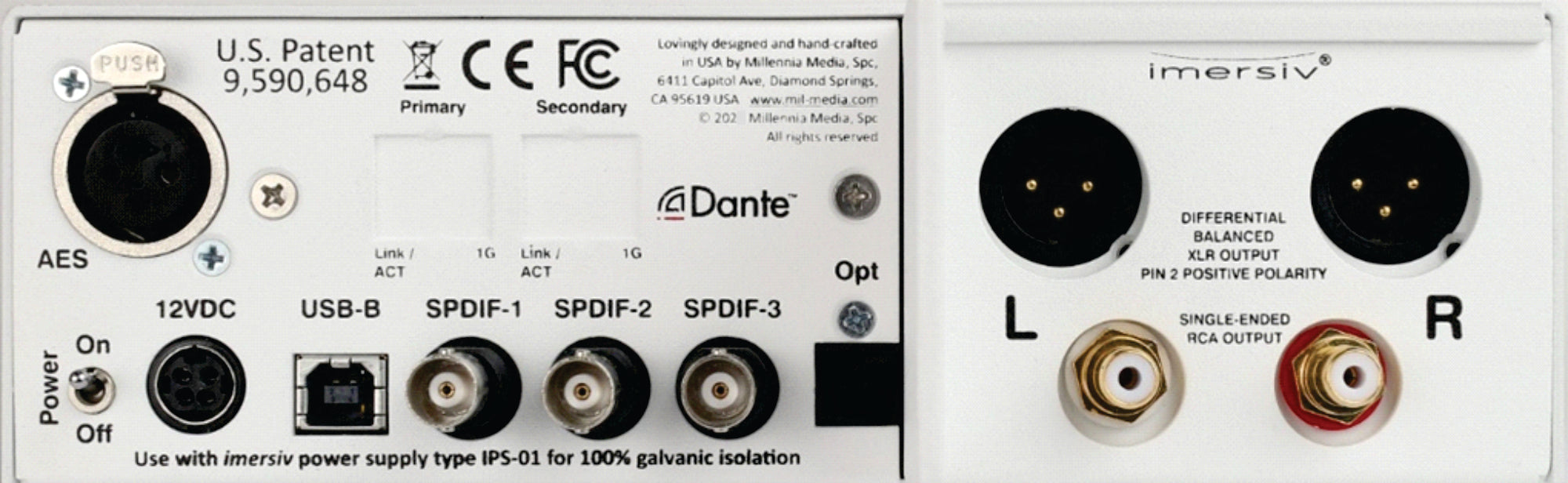
The D-1 accommodates a comprehensive range of digital sources. A USB Type-B input handles up to 384kHz/32-bit PCM and DSD64, DSD128, and DSD256 via DoP. An AES XLR input and three SPDIF BNC inputs serve professional digital sources, while an optical Toslink input handles consumer sources. An optional Dante network audio module provides a 32-bit, jitter-free audio network connection over standard Ethernet, supporting the professional industry standard network protocol for up to 64 audio channels on a single RJ45 connector.
Differential-balanced XLR outputs are the primary analog output, specified to drive true floating diff-bal receivers for full HDR-A performance. RCA outputs are available in parallel but are not performance-specified for all interconnect configurations due to the nature of the balanced output architecture. Optional accessories -- the Subwoofer Breakout Box (SBB) and UTB Transformer Interface Box -- are available for installations requiring RCA connectivity while preserving the 168dB balanced signal path. DSD via DoP has been confirmed compatible with J-River, Foobar2000, HQPlayer, and Audirvana. MusicBee is also supported but auto-converts DSD to 96kHz PCM by default and requires an ASIO driver for bit-perfect DoP transfer.
Signal Processing, Level Control, and Features
A DSP-managed system handles path routing, cross-fading, calibration, and a wide range of user-adjustable functions. Six selectable digital filter variants allow listeners to match the filter response to their preferences and source material. A selectable 192kHz resampling mode up-converts incoming signals before processing -- a useful option for lower-sample-rate material such as 44.1kHz CD audio, pushing any potential filter artifacts well outside the audible band.
An integrated 154dB-range level control (adjustable in 0.1dB or 1.0dB steps) allows the D-1 to serve as a preamplifier feeding a power amplifier directly, which Imersiv recommends as the optimal configuration for maximizing low-path performance. Unlike an analog volume control, this DSP-based level adjustment does not affect the analog noise floor at any setting -- the level control functions as a DSP window, shifting the digital bit-group without altering the analog gain structure.
A Pro Menu (accessed via front-panel button combination) provides functions oriented toward mastering and professional use: Left/Right balance matching to 0.01dB, M/S (mid-side) width adjustment, a selectable harmonic distortion generator producing variable amounts of second-harmonic coloration for applications where "analog warmth" is desired, and a monitor level lock. Two latency settings accommodate both standard studio monitoring and low-latency Foley or performance applications.
Engineering and Construction
The D-1 is built on Millennia's four decades of aerospace-grade PCB fabrication and quality control, and is manufactured in Diamond Springs, California. The chassis uses a dual-enclosure approach: an outer aluminum chassis houses the digital and DSP PCBs, while a fully enclosed internal steel sub-chassis isolates the analog DAC section. Aluminum provides effective RF shielding for the digital circuits; steel provides electrostatic shielding for the 40nV analog output stage, which is vulnerable to airborne E-field energy common in homes and studios. A 10-gauge aluminum RF shield plate runs the full interior length of the chassis, separating digital and analog sections.
Power is supplied by a galvanically isolated external switch-mode supply (model IPS-01), chosen specifically to eliminate ground-induced noise and jitter on the USB and Dante interfaces. Twenty-three individual stages of ultra-low-noise downstream regulation further isolate the sensitive analog circuitry. Low-jitter clocking operates in the femtosecond region. DC offset is held to 20uV maximum at quiescent, maintained by machine-learning-based self-calibration algorithms that also manage optimal cross-fade linearity between the two signal paths.
Imersiv holds three U.S. patents covering the HDR-A D-to-A conversion architecture: the original multi-path DAC patent, a second covering multi-path ADC and DAC applications using pulse density modulated (DSD) signals, and a third covering multi-path power amplification with tight integration to multi-path D-to-A conversion. Additional patents are in process covering further extensions of the HDR-A topology.
Pro Pedigree and Critical Reception
Prior to production release, over forty Grammy-winning recording engineers and film composers evaluated the D-1 in a year-long private beta test across professional studios, including engineers at Skywalker Ranch. Paul Blakemore, multi-Grammy-winning chief mastering engineer at Concord Music, described the experience: "The depth and low-level detail is breathtaking." Other engineers described it as "like switching from 35mm to IMAX" and reported that during sessions, clients "thought they were hearing a 3D mix."
In a December 2024 review published in Positive Feedback (Issue 137), mastering engineer and senior technical editor Bob Katz evaluated the D-1 alongside other components, calling the products under review a new audio paradigm and a redefinition of the state of the art -- a significant assessment from a reviewer with deep technical knowledge of DAC design. The D-1 received the Grand Prize in the 2025 Create the Future Design Contest, sponsored by SAE Media Group, selected from over 630 entries by 54 independent judges. Coverage also includes reviews in Tape Op Magazine (April 2025), Recording Magazine (December 2025), Audio Xpress (November 2025), and Twittering Machines (March 2026).
For Audiophiles: System Integration and Listening
For home audiophile systems, Imersiv recommends connecting the D-1 directly to a power amplifier with at least 20dB of gain, using the D-1's level control as the system volume control. This maximizes the time the signal spends in the low-path processing region -- where HDR-A delivers its most audible advantage in atmospheric realism, spatial depth, and instrument timbre. A power amplifier with 30dB or more of gain is ideal. No preamplifier is required; if a preamp must be used, a hard-wire bypass mode is preferred.
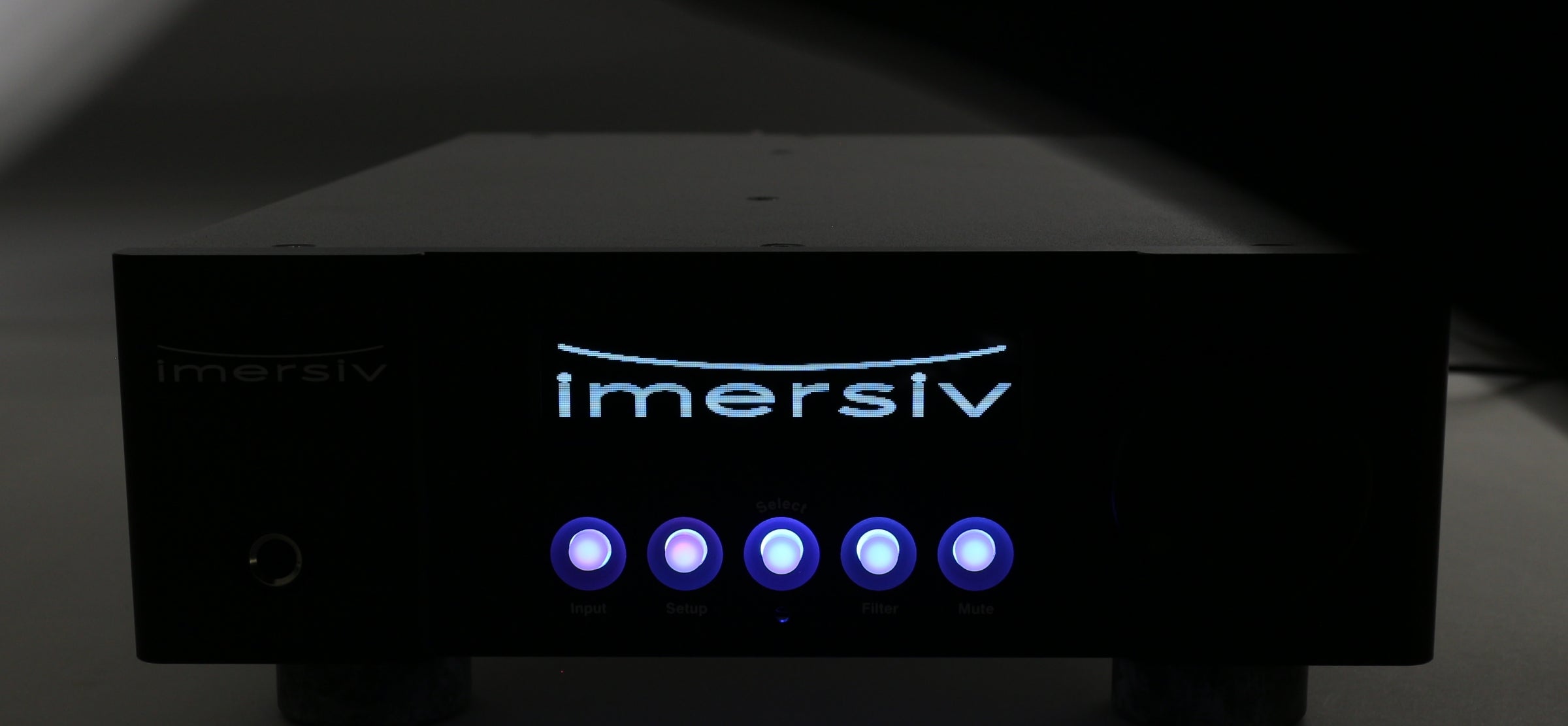
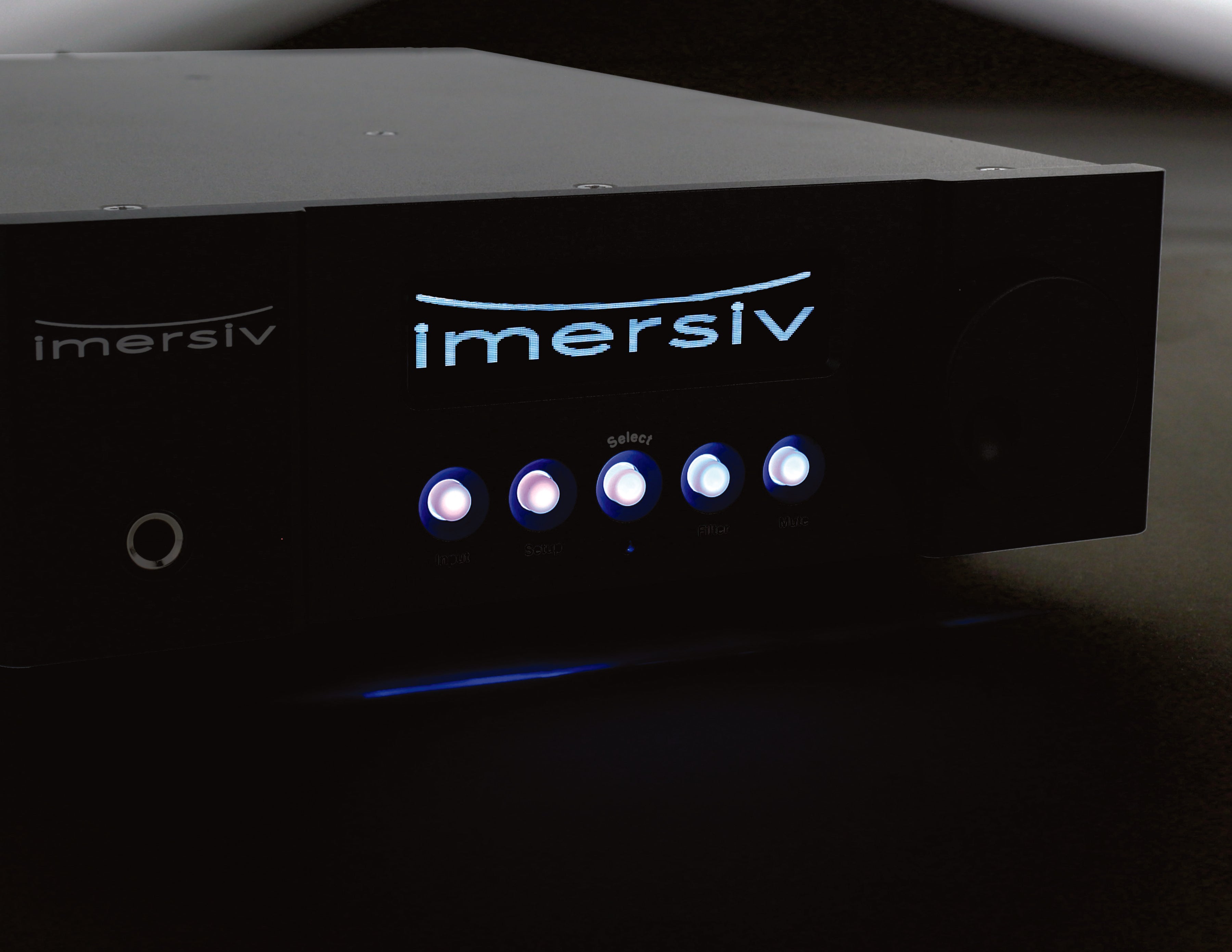
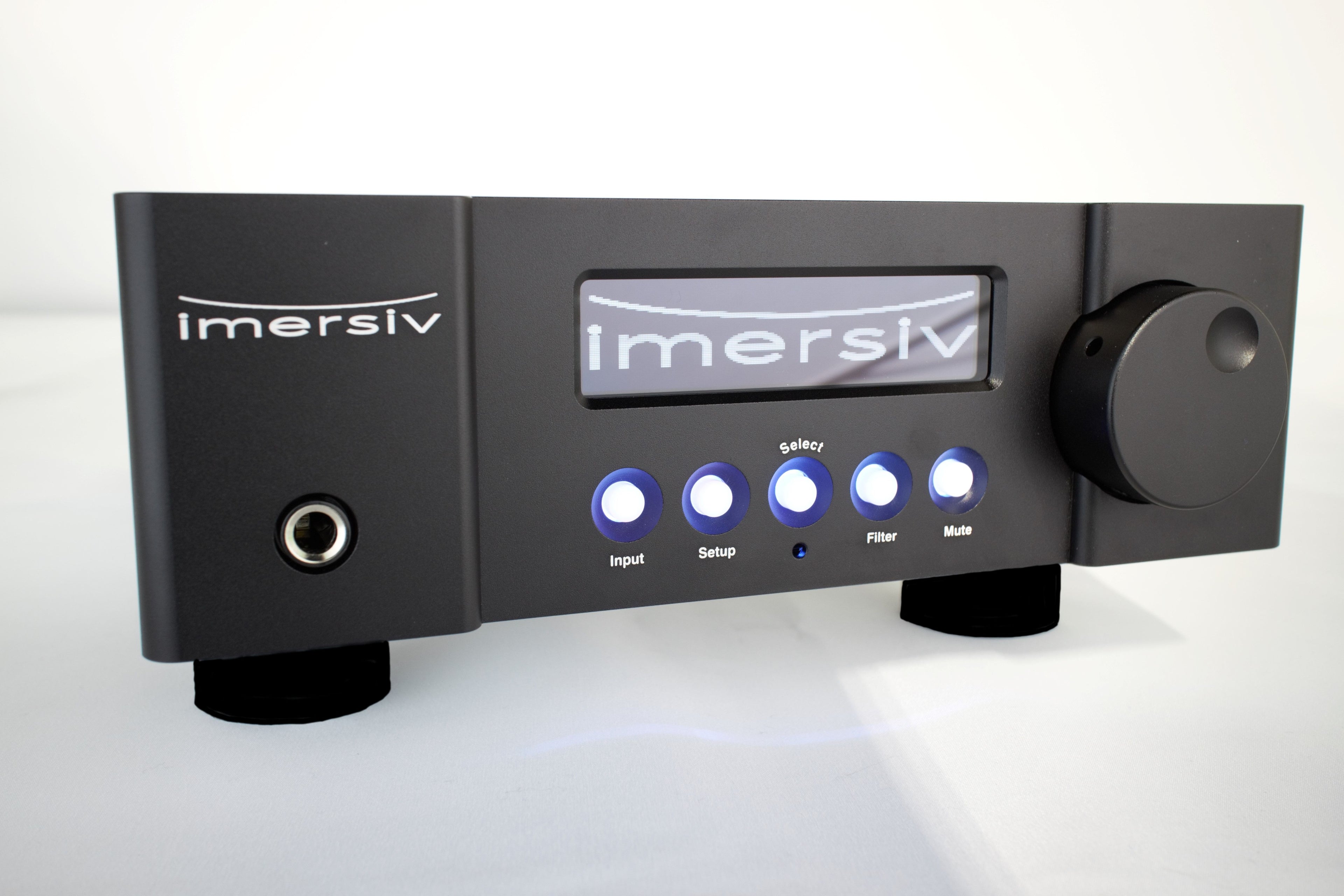
Program material with wide dynamic range -- classical music, acoustic jazz, film scores, and high-resolution acoustic recordings -- will most clearly reveal the D-1's improvements. The unit includes a headphone output capable of driving loads from 32 to 600 ohms at up to 2.8W, making it equally capable as a desktop headphone DAC. The D-1 does not support MQA -- a deliberate design choice, as Imersiv considers bit-perfect high-resolution PCM and DSD the preferred delivery formats. A front-mounted OLED display (256 x 64 pixels) provides input, level, and status readout, with a display-off option to protect long-term OLED uniformity. The Imersiv D-1 DAC represents a singular advance in digital audio conversion, bringing multi-path HDR-A architecture to both professional and home listening environments.




 Pay $0 today
 Trial
Trial
 Pay
Pay