Skip to product information
1 of 7

Gryphon

Gryphon Apex Power Amplifier

Regular price
$114,500.00 USD
Regular price
Sale price
$114,500.00 USD
Configuration

This product is available by consultation. Contact us to get started.


Free shipping

Contact us for estimated shipping date

Overview

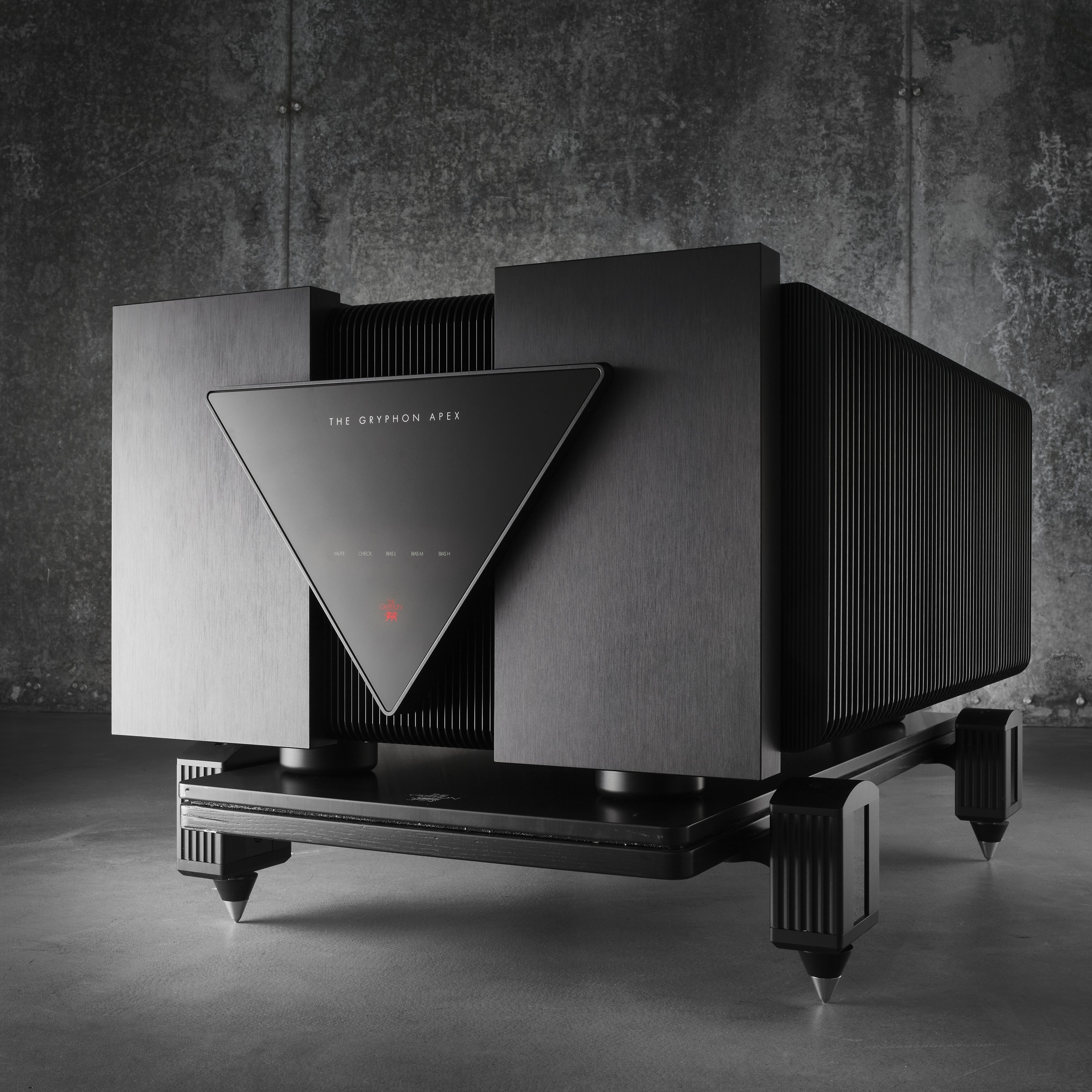
The Gryphon Apex is a Class A power amplifier offered in stereo and dedicated mono versions. It delivers 210 W per channel into 8 ohms in stereo or 225 W per mono amplifier. Each chassis contains two 2 kVA transformers, 1,040,000 µF of capacitance, and 64 output transistors. Balanced XLR inputs, adjustable bias, and Green Bias control support system integration.

Specifications

Configurations and output

  • Listed configurations: Stereo amplifier; Mono Pair.
  • Stereo output, per channel: 210 W/8 Ω; 420 W/4 Ω; 800 W/2 Ω; 1,490 W/1 Ω.
  • Mono output, per amplifier: 225 W/8 Ω; 450 W/4 Ω; 880 W/2 Ω; 1,690 W/1 Ω.
  • Rating supply conditions: 115/230 V AC.
  • Class A rating: High bias, 210 W/channel stereo or 225 W/mono amplifier into 8 Ω.

Circuit and supply, per chassis

  • Transformers: 2 × 2,000 VA (2 kVA each; 4 kVA combined).
  • Reservoir capacitance: 1,040,000 µF (1.04 F).
  • Output devices: 64 bipolar transistors.
  • Topology: Balanced differential Class A circuitry; JFET input buffer; DC servo; no global negative feedback.
  • Construction: Four-layer PCBs; copper up to 105 µm; silver internal wiring; damped aluminum chassis.
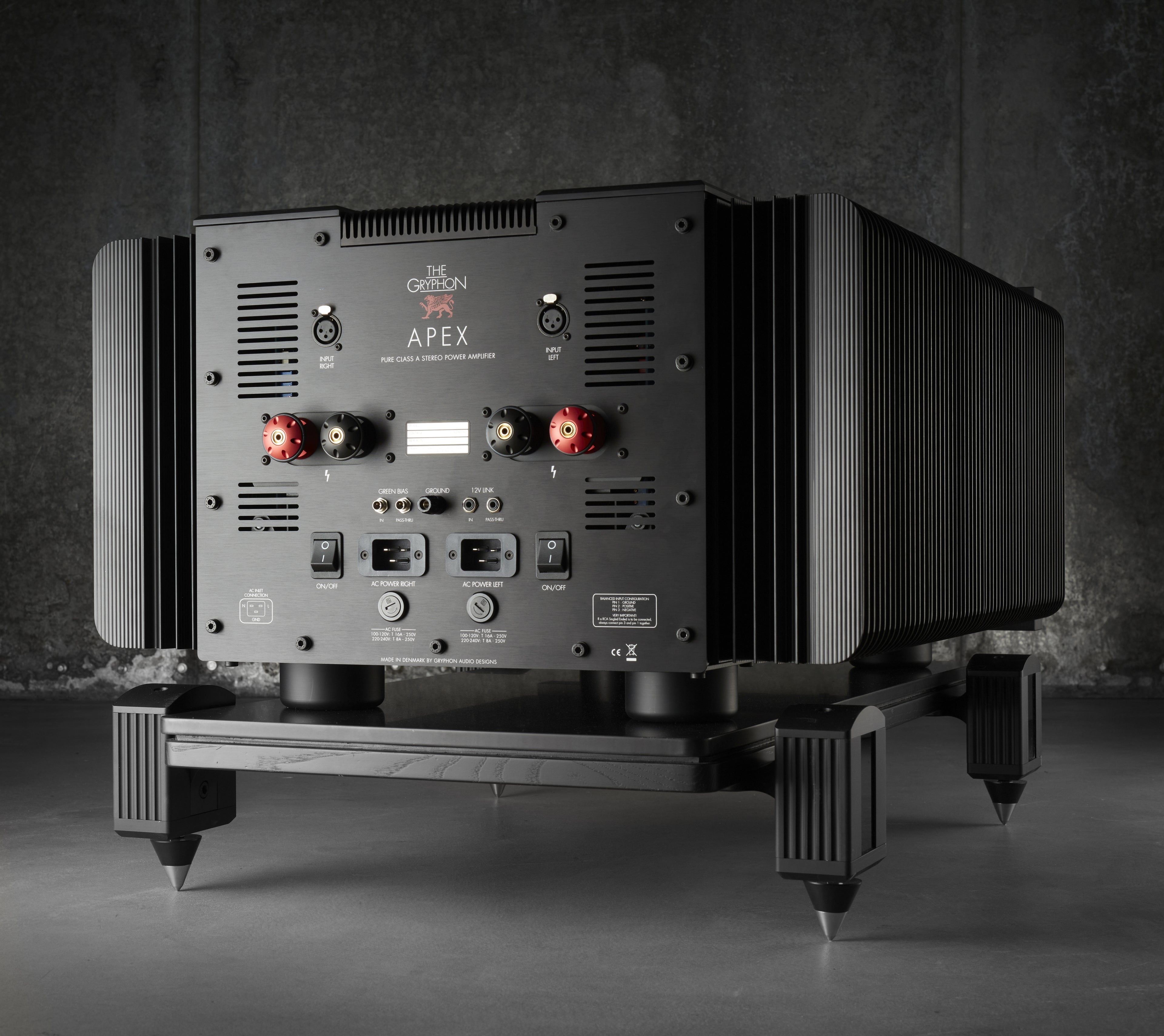
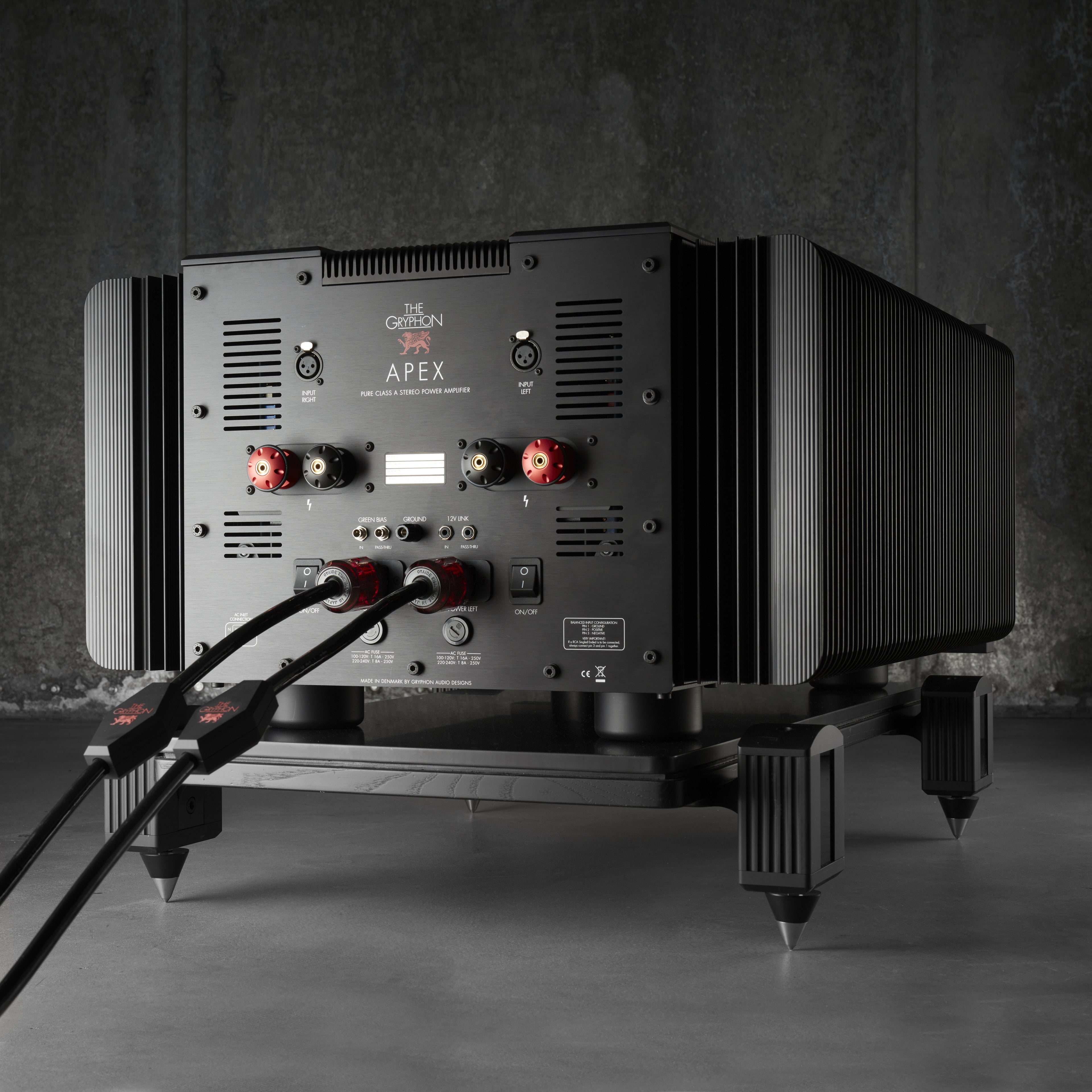
  • Inputs: Stereo, 1 XLR per channel; mono, 1 XLR input and 1 XLR pass-through.
  • Speaker terminals: Gryphon binding posts; bare wire, spades, or 4 mm bananas.

Electrical specifications

  • Gain: 31 dB.
  • Input level: Stereo 1.16 Vrms; mono 1.20 Vrms.
  • Balanced input impedance, 20 Hz–20 kHz: Stereo 20 kΩ; mono 10 kΩ.
  • Output impedance: Stereo 0.015 Ω; mono 0.010 Ω.
  • Bandwidth, −3 dB: 0.3 Hz–330 kHz.
  • THD+N / IMD (DFD): Each <0.02% at 50 W/8 Ω.
  • Noise: <−80 dBV unweighted, 20 Hz–20 kHz; <−86 dBV A-weighted.

Operation and physical specifications

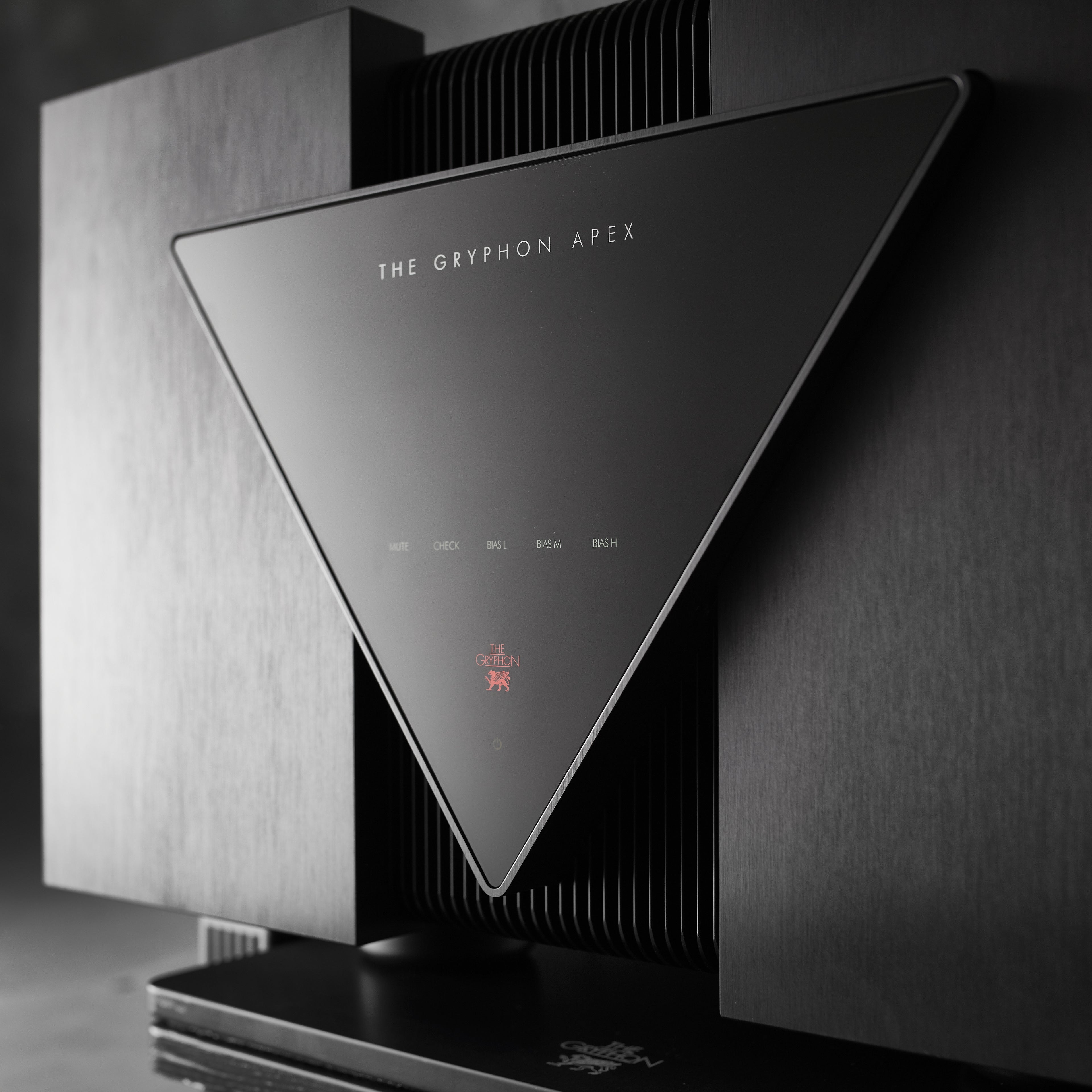
  • Bias: Low/Medium/High; manual or Green Bias control; Medium provides 100 W Class A.
  • Idle consumption, per chassis: High 1,000 W; Medium 660 W; Low 320 W.
  • Maximum consumption: 3,700 W per chassis.
  • Standby: <0.5 W per chassis.
  • AC inlets: 2 × IEC C20 per chassis, for cords with C19 equipment connectors.
  • Control: 12 V link; Green Bias; AC polarity indicator; USB firmware updates; protection and soft start.
  • Dimensions, W × H × D: 593 × 371 × 886 mm (23.35 × 14.61 × 34.88 in), per chassis.
  • Net weight: 202 kg (445.3 lb) per chassis.
  • Manufacturer warranty: 5 years, subject to applicable terms.
  • Manufacture: Denmark.
Gryphon Apex Pure Class A Power Amplifier

The engineering behind the Gryphon Apex

Apex is Gryphon’s flagship power amplifier, offered as a stereo model or as dedicated mono amplifiers. Its scale comes from the output stage, power supply, and cooling required for its Class A operating range. The stereo and mono versions share the chassis format but differ in their output and input specifications.

Output stage and supply architecture

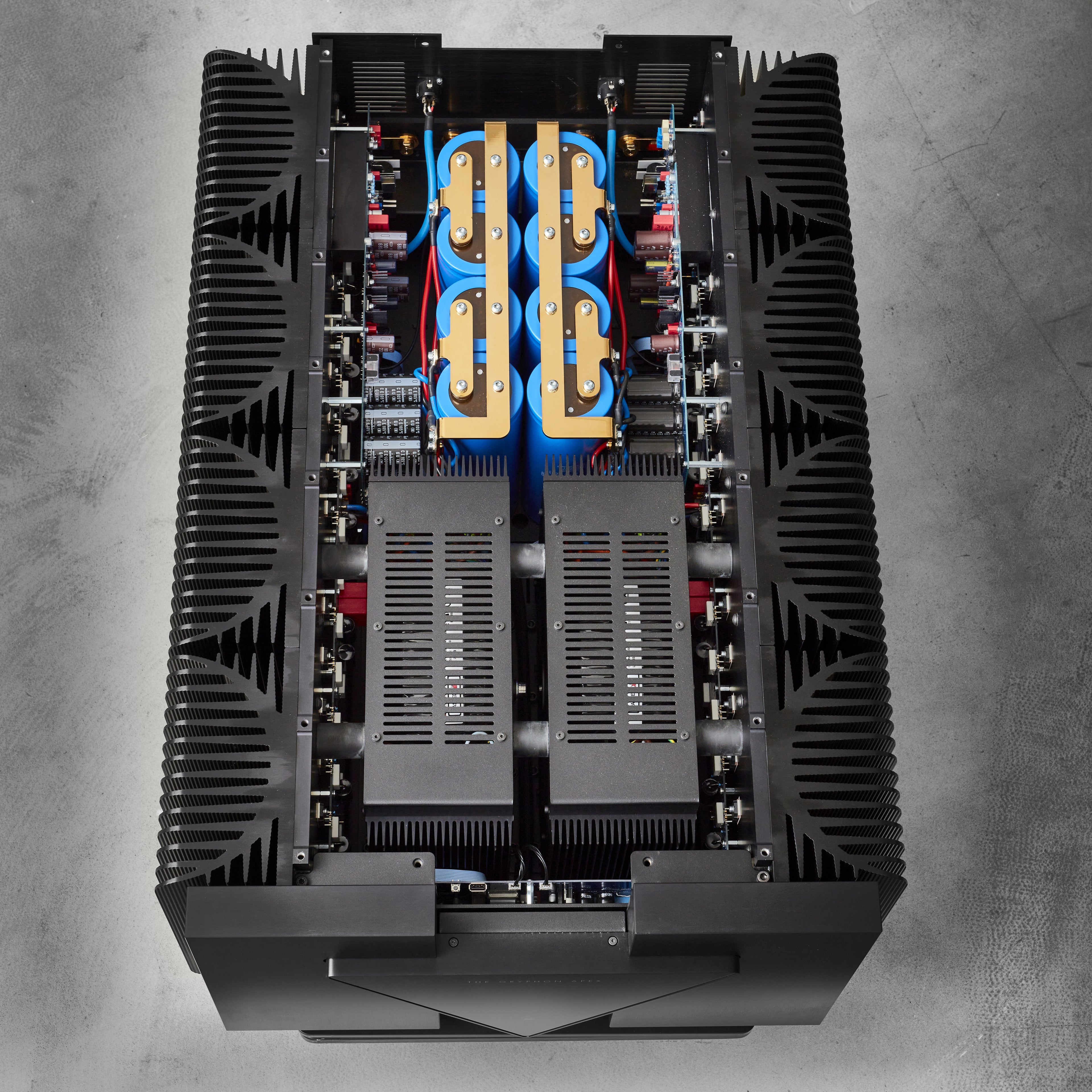
Each chassis contains 64 high-current bipolar output transistors, two 2 kVA toroidal transformers, and 1,040,000 µF of reservoir capacitance. The two transformers have individually decoupled castings. Regulated supplies serve the voltage-amplification stages, while separate linear supplies serve the analog and control circuitry.

The driver circuitry has its own supply provision, and local foil capacitors provide decoupling close to the amplification stages. This separates several supply functions rather than relying on one reservoir to serve every circuit in the chassis.

Stereo output is 210 W per channel into 8 ohms, rising to 420 W into 4 ohms. Each mono amplifier is rated at 225 W and 450 W respectively. Ratings extend to 1-ohm loads, but system matching still depends on the speaker’s impedance curve, sensitivity, room, and listening levels. The mono version’s published output impedance and input impedance also differ from the stereo model.

Circuit and construction

A low-capacitance JFET Class A input buffer feeds balanced differential circuitry and a symmetrical voltage-amplification stage. The circuit uses no global negative feedback, with DC servo coupling and balanced XLR inputs.

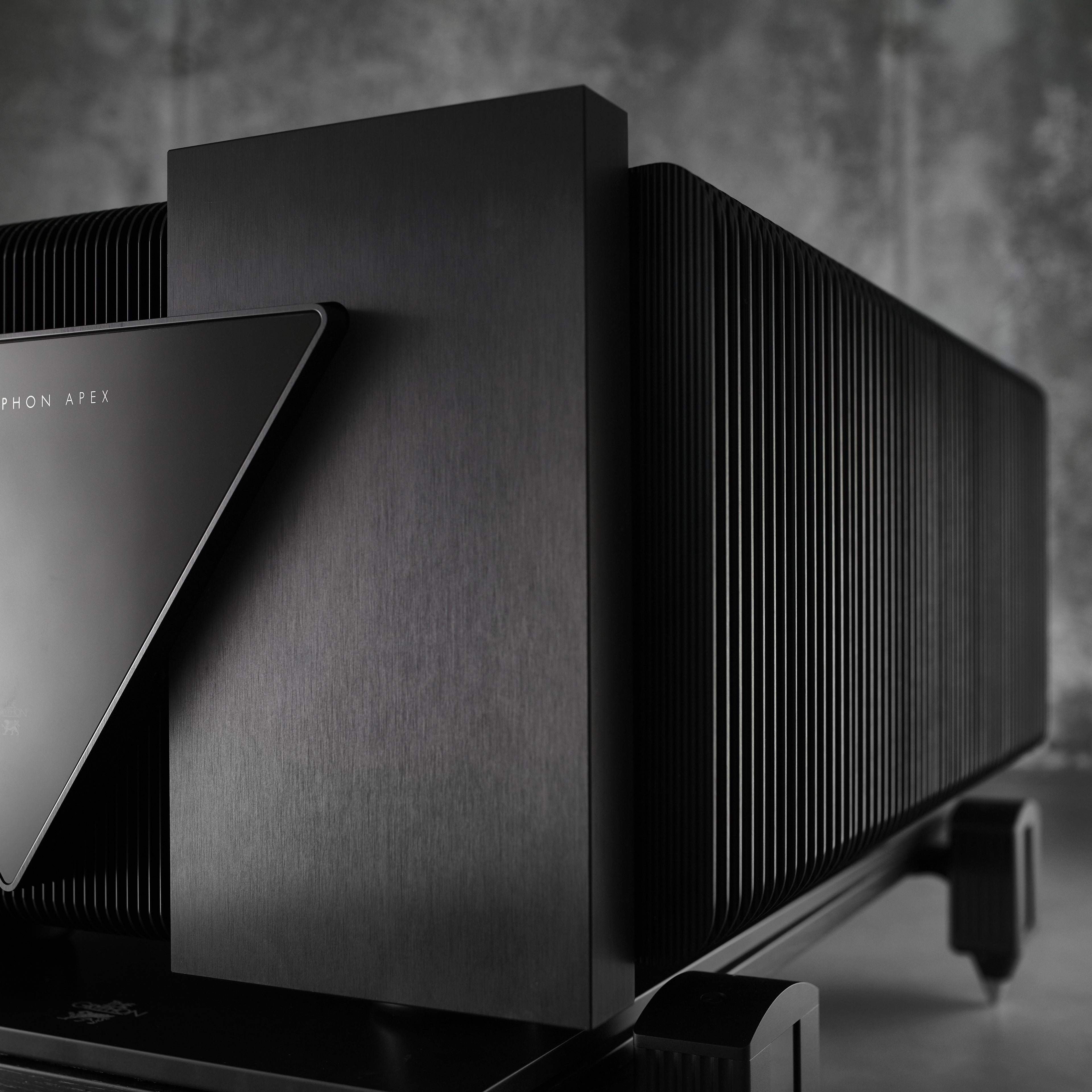
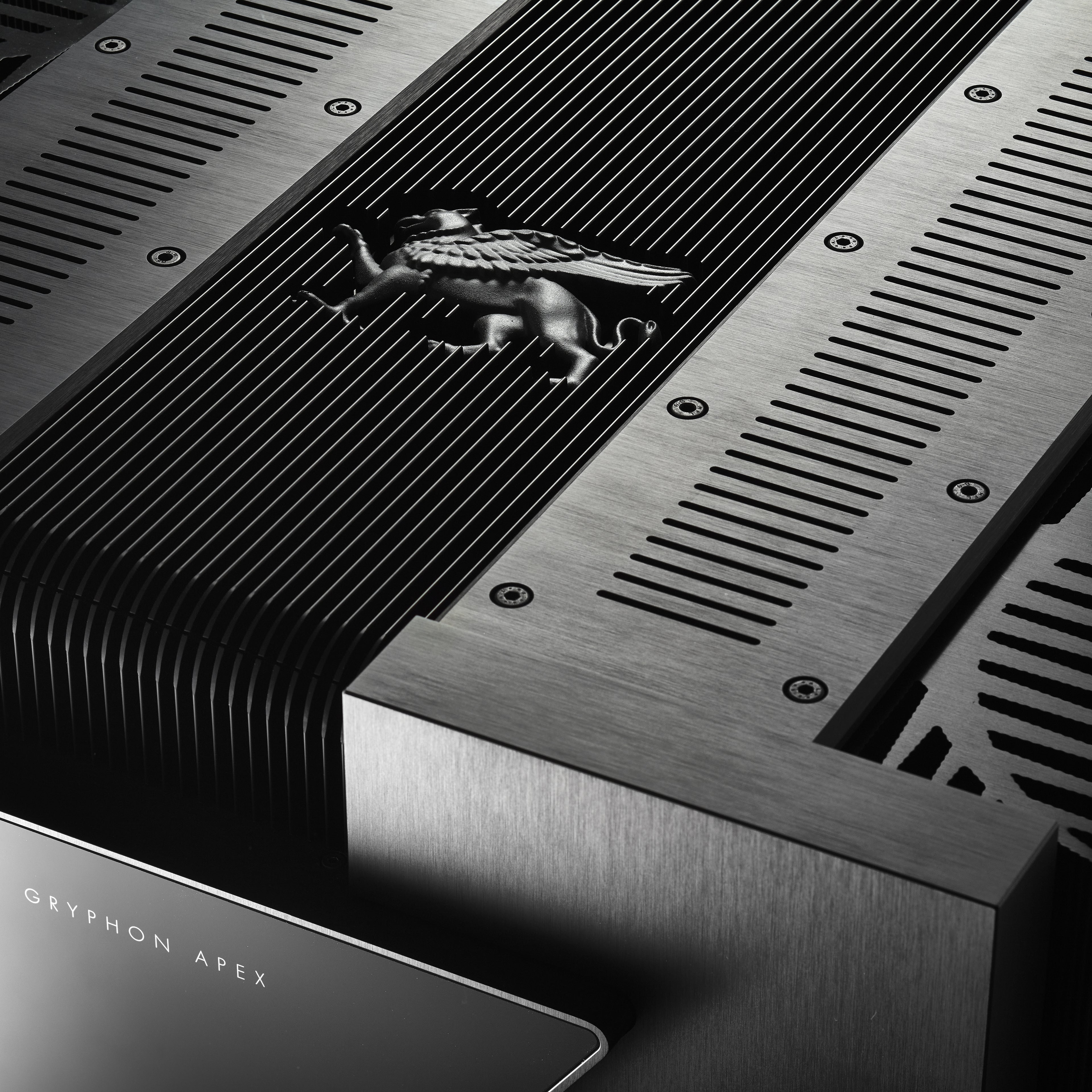
Four-layer circuit boards have copper traces up to 105 µm thick. Silver internal signal and power wiring, a damped aluminum enclosure, and substantial heatsinks complete the physical implementation. The heatsinks are part of the amplifier’s thermal design: High-bias idle consumption is 1,000 W per chassis, so the effect on the listening room matters during ownership.

Bias and everyday operation

Low, Medium, and High bias settings change the range over which the amplifier operates in Class A. High provides the published 8-ohm Class A rating; Medium provides 100 W of Class A operation. Lowering bias does not reduce the total output-power rating.

With a compatible Gryphon preamplifier, Green Bias selects between operating points according to configured volume-control thresholds. It is a separate control connection. Manual selection remains available with other preamplifiers.

The front controls provide bias selection, mute, and standby. A soft-start circuit manages turn-on current, while 12 V linking supports remote power control. Firmware can be updated by USB.

Apex at Unveil Sound

Compared with Hyperion, Apex has a larger transformer provision, capacitor bank, and output-device complement per chassis. Whether that scale is worthwhile depends on the rest of your system and what you want to achieve.

We can help you evaluate the stereo or mono configuration around your speakers, preamplifier, listening preferences, and the practical demands of Class A operation in your home.

Discuss your Apex system. Explore Gryphon.

A few things you may be wondering

From booking a session to planning your next upgrade, here are answers to common questions about working with Unveil Sound.

How can I book a private listening appointment?

Call or text us at (360) 360-3610, email hello@unveilsound.com, or use our website's contact form. Every appointment begins with a consultation about your current system, room, musical preferences and goals. We then schedule your visit and prepare the space for you.

What equipment can I audition at your studio?

You can audition a selection of reference components from the brands we carry. During your consultation, tell us what you would like to hear and we will confirm availability and create the experience for your visit.

Do you accept trade-ins?

Yes. However, we consider trade-ins case by case, based on the equipment, its condition, and current market demand. Contact us and we will let you know whether we can accept your equipment.

How does the free one-year Trade-Up credit work?

Our Trade-Up Program gives you full store credit for the amount paid toward a higher-tier item, for up to one year after your purchase. Some exceptions apply. Items that do not qualify may still be considered as a regular trade-in. For complete terms, please review our Trade-Up Program details.

Can I purchase from Unveil Sound if I live outside the Pacific Northwest?

Yes, we serve clients throughout the United States. Availability of some brands can vary by region, which we discuss during your consultation.

Do you offer delivery, installation, and system setup?

Yes, we can deliver, install, and set up your system anywhere in the United States. For reference-level components, this is included at no additional cost.

Do you ship throughout the United States?

We ship throughout the United States. Availability and shipping arrangements may vary by brand, product, and destination. Contact us to confirm the details for your order.