Skip to product information
1 of 2

Gryphon

Gryphon DAC3 DAC Module

Regular price
$8,400.00 USD
Regular price
Sale price
$8,400.00 USD

This product is available by consultation. Contact us to get started.


Free shipping

Hear it at our studio

Contact us for estimated shipping date

Description

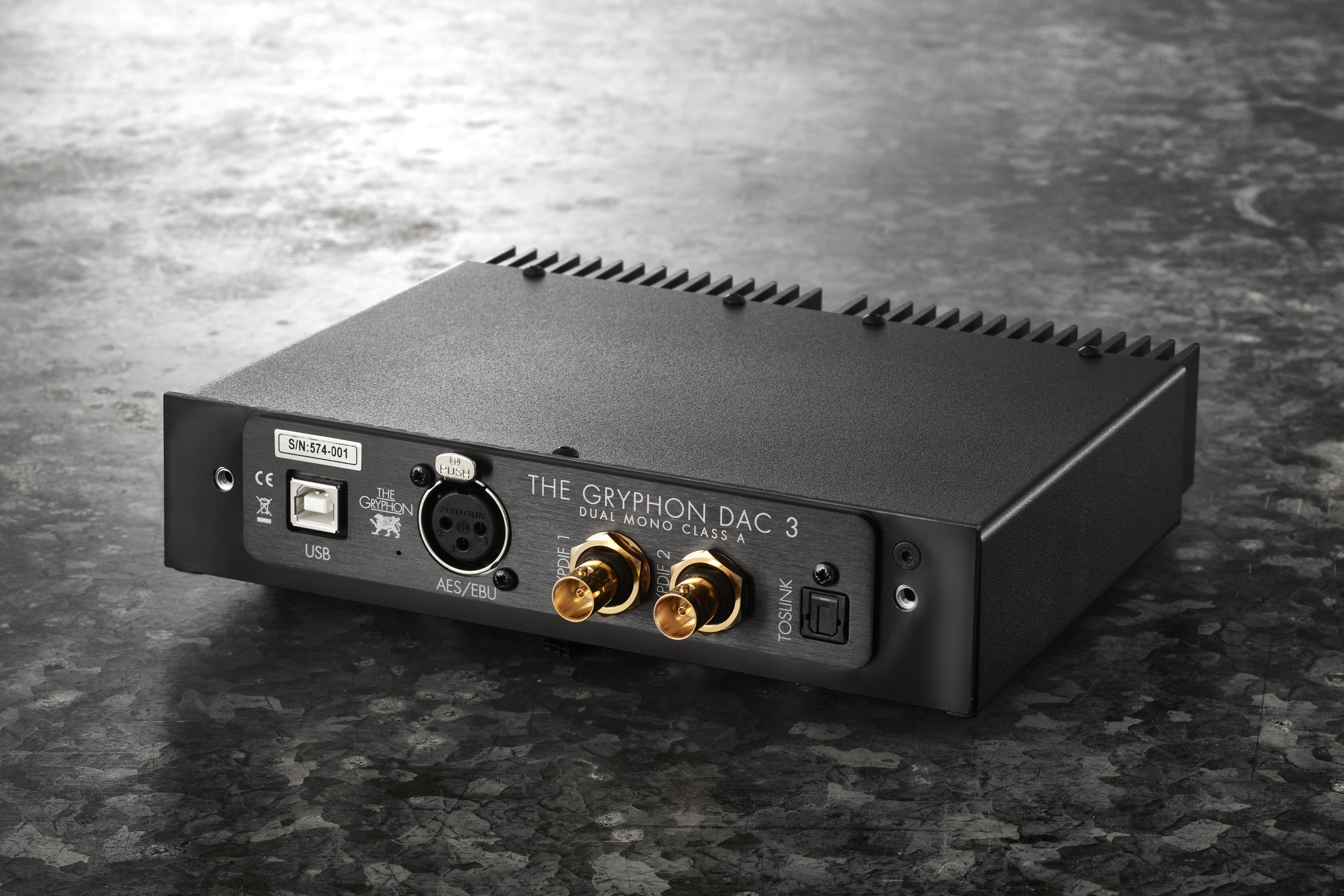
The Gryphon DAC3 is a dual-mono Class A DAC module designed for the Diablo 333 integrated amplifier and Helios preamplifier. Built around the ESS ES9039PRO DAC chip with discrete Class A analog output stages and zero global negative feedback, it adds five digital inputs including USB, AES/EBU, S/PDIF, and TOSLINK. USB accepts PCM to 384kHz and DSD to DSD512. A 12.5 Farad super-capacitor powers the USB module. The Gryphon DAC3 is designed and built in Denmark.

Specifications
  • Type: Dual-mono discrete Class A DAC module (for Gryphon Diablo 333 and Helios)
  • DAC Chip: ESS ES9039PRO
  • Topology: True dual-mono discrete Class A analog output stage; zero global negative feedback
  • Analog Output Stages: Ultra-low noise +/-22VDC regulated voltage supplies; separate left/right ultra-low noise power supply for analog section of ES9039PRO
  • Digital Inputs: USB, AES/EBU (XLR, 110 ohms), 2 x S/PDIF (BNC, 75 ohms), TOSLINK
  • USB Formats: PCM 44.1, 48, 88.2, 96, 176.4, 192, 352.8, 384kHz up to 32-bit; DSD64, DSD128, DSD256, DSD512
  • AES/EBU and S/PDIF Formats: PCM 22.05, 24, 32, 44.1, 48, 64, 88.2, 96, 176.4, 192kHz up to 32-bit
  • TOSLINK Formats: PCM 22.05, 24, 32, 44.1, 48, 64, 88.2, 96kHz up to 24-bit
  • PCM Digital Filters: 7 user-selectable roll-off filters
  • Analog Filters: First-order PCM analog filters; second-order DSD analog filters with polypropylene capacitors
  • Clock: Temperature-compensated ultra-low jitter crystal oscillator; accuracy better than 5 parts per million
  • USB Power Supply: 12.5 Farad super-capacitor bank; acts as isolated battery-like supply
  • Digital Noise Suppression: Multiple local voltage regulators
  • Circuit Boards: Six-layer PCBs
  • Signal Path: Ultra-short; minimal internal wiring; PCB-mounted input sockets
  • Input Connectors: Gold-plated Neutrik XLR (AES/EBU); gold-plated BNC with Teflon insulation (S/PDIF); TOSLINK optical
  • Compatible Host Products: Gryphon Diablo 333 integrated amplifier; Gryphon Helios preamplifier
  • Country of Manufacture: Denmark
Gryphon DAC3 DAC Module

Gryphon DAC3 DAC Module

The Gryphon DAC3 is an internal DAC module designed to add five high-resolution digital inputs to compatible Gryphon components. Built around the ESS ES9039PRO DAC chip with a dual-mono discrete Class A analog output stage and zero global negative feedback, it brings Gryphon's core analog design principles to digital source playback. The DAC3 is compatible with the Diablo 333 integrated amplifier and the Helios preamplifier, and is installed by an authorized Gryphon dealer.

What the DAC3 Does

The DAC3 occupies one of the expansion module slots on the rear panel of the Diablo 333 or Helios and adds five digital inputs to the host component: USB, AES/EBU (balanced XLR), two S/PDIF (BNC), and TOSLINK. Once installed, the host component's display shows the selected digital input number, sampling frequency, PCM or DSD format, and the active digital filter setting. The DAC3 is managed entirely through the host component's menus and remote control, with no additional user interface of its own.

Digital Input Formats

USB accepts PCM at sample rates from 44.1kHz to 384kHz at up to 32-bit word length, and DSD in all four standard rates: DSD64, DSD128, DSD256, and DSD512. No drivers are required for Mac or Linux. AES/EBU via XLR and S/PDIF via BNC both handle PCM up to 192kHz at 32-bit. The TOSLINK optical input accepts PCM up to 96kHz at 24-bit. Seven user-selectable PCM digital roll-off filters are provided, allowing fine-tuning of the digital presentation without leaving the listening position.

Analog Output Stage

The analog output stage following the ES9039PRO is a true dual-mono, fully discrete Class A design with zero global negative feedback, built on separate left and right channel ultra-low noise power supplies. Analog output stage supplies run at +/-22VDC, regulated to ultra-low noise levels for best THD and noise performance. First-order analog filters are applied after PCM conversion; second-order analog filters are used after DSD conversion, both using polypropylene capacitors. Multiple local voltage regulators suppress digital noise from reaching the analog stages. The signal path is kept as short as possible with PCB-mounted input sockets eliminating internal wiring.

USB Power Supply

The USB input module is powered by a 12.5 Farad super-capacitor bank rather than a direct AC-mains-derived supply. Gryphon describes this as acting like a true battery supply, providing a stable, isolated power source for the USB receiver that is fully separated from the AC mains and its associated noise. When the host component is powered on, the super-capacitor bank charges before the USB input becomes available. In the Diablo 333 and Helios, a blue LED on the front panel indicates when charging is in progress, and the USB input is active once the LED stops blinking.

Clock and Jitter

A temperature-compensated crystal oscillator with accuracy better than 5 parts per million provides the reference clock for the DAC3. Gryphon describes this as ultra-low jitter, contributing to the stability and precision of the digital-to-analog conversion process across all supported input formats and sample rates.

Circuit Construction

The DAC3 is built on six-layer printed circuit boards, a higher layer count than the four-layer boards used in the main amplification circuitry of the Diablo 333 and Helios. The increased layer count allows more effective separation of digital and analog ground planes, reducing the risk of digital noise coupling into the sensitive analog output stages. All input sockets are PCB-mounted to keep the signal path short and free of internal wiring.

A few things you may be wondering

From booking a session to planning your next upgrade, here are answers to common questions about working with Unveil Sound.

How can I book a private listening appointment?

Call or text us at (360) 360-3610, email hello@unveilsound.com, or use our website's contact form. Every appointment begins with a consultation about your current system, room, musical preferences and goals. We then schedule your visit and prepare the space for you.

What equipment can I audition at your studio?

You can audition a selection of reference components from the brands we carry. During your consultation, tell us what you would like to hear and we will confirm availability and create the experience for your visit.

Do you accept trade-ins?

Yes. However, we consider trade-ins case by case, based on the equipment, its condition, and current market demand. Contact us and we will let you know whether we can accept your equipment.

How does the free one-year Trade-Up credit work?

Our Trade-Up Program gives you full store credit for the toward a higher-tier item, for up to one year after your purchase. Some exceptions apply. Items that do not qualify may still be considered as a regular trade-in. For complete terms, please review our Trade-Up Program details.

Can I purchase from Unveil Sound if I live outside the Pacific Northwest?

Yes, we serve clients throughout the United States. Availability of some brands can vary by region, which we discuss during your consultation.

Do you offer delivery, installation, and system setup?

Yes, we can deliver, install, and set up your system anywhere in the United States. For reference-level components, this is included at no additional cost.