Luxman L-100 Centennial
The Luxman L-100 Centennial is a pure Class-A integrated amplifier created to mark LUXMAN's 100th anniversary, and it represents the company's first integrated amplifier to incorporate the new LIFES 1.1 amplification feedback engine. Rated at 20W per channel into 8 ohms and 40W into 4 ohms, it is built for listeners who prioritize density of tone and tonal accuracy over headline power figures. Every circuit, component, and mechanical element has been developed with the singular goal of preserving the integrity of the musical signal from input to loudspeaker.
Position Within the LUXMAN Lineup
The L-100 Centennial occupies the pinnacle of LUXMAN's integrated amplifier range and is part of the broader Centennial series alongside the D-100 Centennial SACD player and the P-100 Centennial headphone amplifier. All three share the same chassis design language, including the brushed white front panel finish, chrome "CENTENNIAL" nameplate, and cast-iron insulator feet. The L-100 Centennial is the first pure Class-A integrated amplifier from LUXMAN in approximately nine years, and the first to deploy LIFES, the company's completely reimagined successor to its long-running ODNF amplifier technology.
Pure Class-A Operation
The L-100 Centennial operates entirely in Class-A, meaning the output devices conduct at all times regardless of signal level. This mode of operation eliminates crossover distortion, which is the primary sonic liability of Class-A/B designs, and delivers the smooth, densely musical character that defines Class-A amplification at its best. The output stage uses a triple-paralleled bipolar push-pull configuration, which provides both the headroom and the tonal richness to exploit the full potential of the Class-A operating region. The damping factor is rated at 300, indicating a firm, controlled grip on loudspeaker drivers. Class-A operation generates heat as a by-product, and the L-100 Centennial is designed to run warm under normal use. An auto power-save mode activates after 20 minutes of silence, reducing power consumption during periods of inactivity.
LIFES 1.1 Amplification Feedback Engine
At the core of the L-100 Centennial is LIFES 1.1 (Luxman Integrated Feedback Engine System), the latest evolution of LUXMAN's proprietary amplifier feedback technology. LIFES descends from ODNF (Only Distortion Negative Feedback), a philosophy LUXMAN has refined over more than two decades. The fundamental principle is that only the distortion components generated during amplification are fed back and corrected, leaving the original audio signal entirely untouched. Conventional negative feedback, by contrast, degrades the signal in the process of correcting it.
In the L-100 Centennial, LIFES 1.1 employs paralleled differential detection circuitry at the input stage to achieve an additional reduction in distortion compared to the previous LIFES implementation. THD is rated at 0.005% or less at 1 kHz into 8 ohms, and 0.015% across the full 20 Hz to 20 kHz range. The line-level S/N ratio reaches 98 dB or more, reflecting the low noise floor that LIFES enables by avoiding the broad-spectrum signal degradation of traditional feedback topologies.
LECUA1000 Volume Control
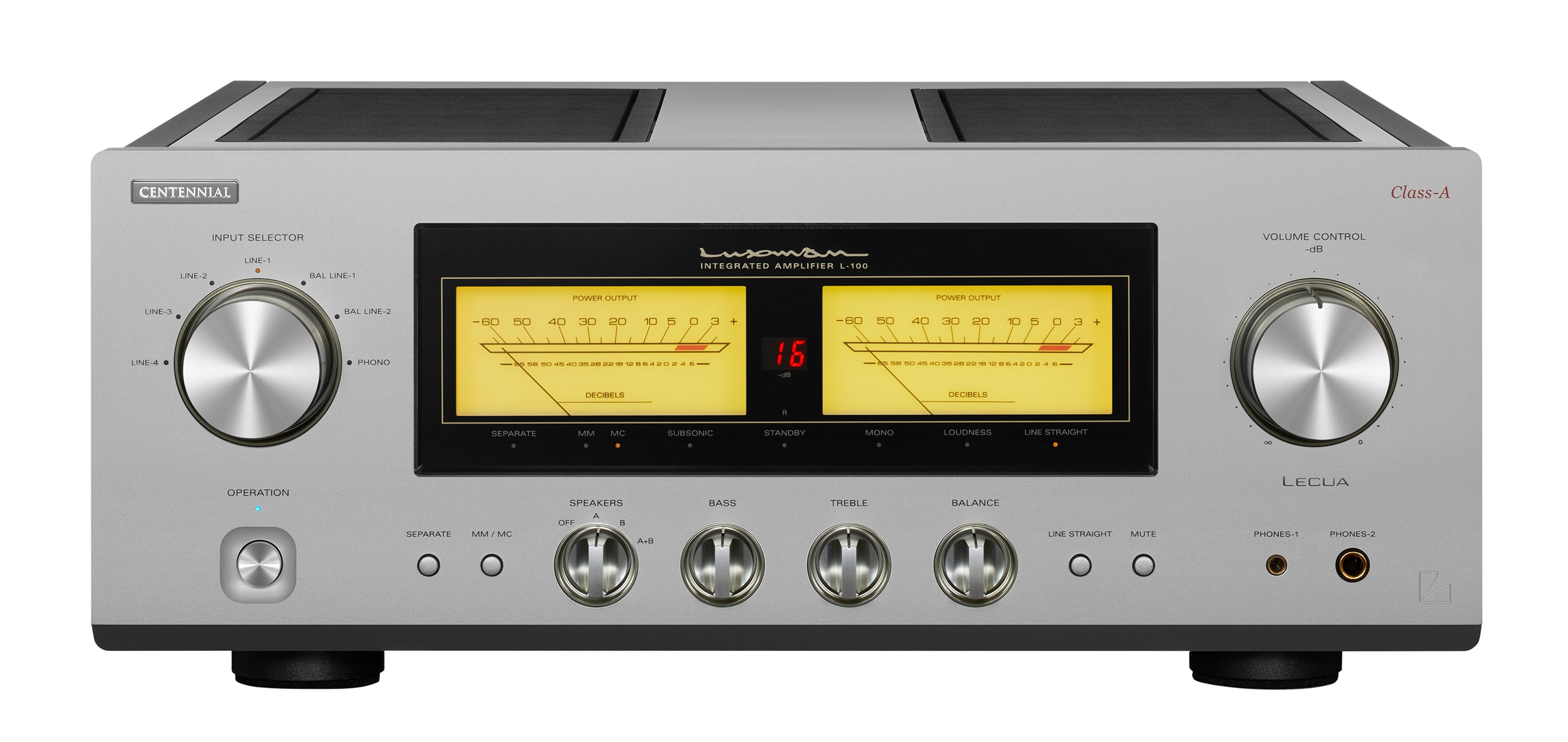
Volume adjustment is handled by the newly developed LECUA1000 (Luxman Electronically Controlled Ultimate Attenuator), an 88-step electronically controlled attenuator integrated directly into the amplifier circuitry. By connecting the attenuator and amplification stages without an intermediate buffer in the signal path, LUXMAN shortens the signal route and reduces the number of components the audio signal must pass through. High-grade discrete buffer circuitry, derived from LUXMAN's flagship preamplifiers, is employed at the preamp output stage to maintain drive capability. The current attenuation level is shown on a 7-segment LED display positioned between the dual power meters, allowing precise volume monitoring from the listening position.
Power Supply
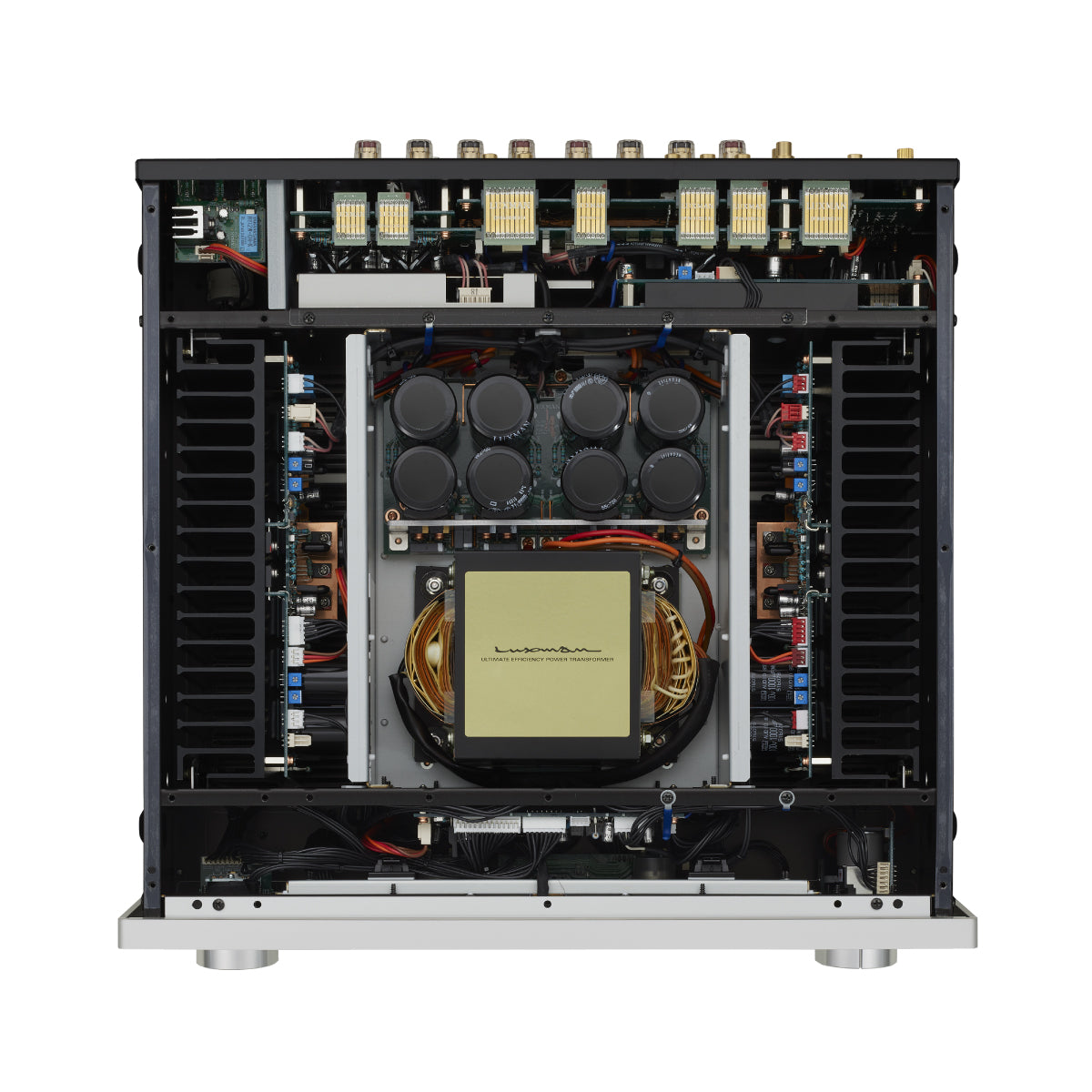
The power supply is built around a custom-designed EI-core transformer regulated by eight large filter capacitors totaling 80,000µF (8 x 10,000µF). This substantial energy reservoir delivers exceptional transient response and stable power delivery under all load conditions. Power consumption is rated at 260W under full signal and 210W under no-signal conditions, with a standby draw of 0.5W. The chassis uses loop-less construction to minimize ground impedance and reduce magnetic interference between circuit sections.
Phono Stage
A high-quality MM/MC phono amplifier is built in, supporting both moving magnet and moving coil cartridges. MM sensitivity is 2.5 mV at 47 kΩ input impedance; MC sensitivity is 0.3 mV at 100 Ω. The phono frequency response is rated at 20 Hz to 20 kHz within ±0.5 dB, and the S/N ratio is 80 dB or more for MM and 65 dB or more for MC. A dedicated cartridge selection button on the front panel switches between MM and MC modes. A subsonic filter is also available for use with turntable sources.
Inputs, Outputs, and Connectivity
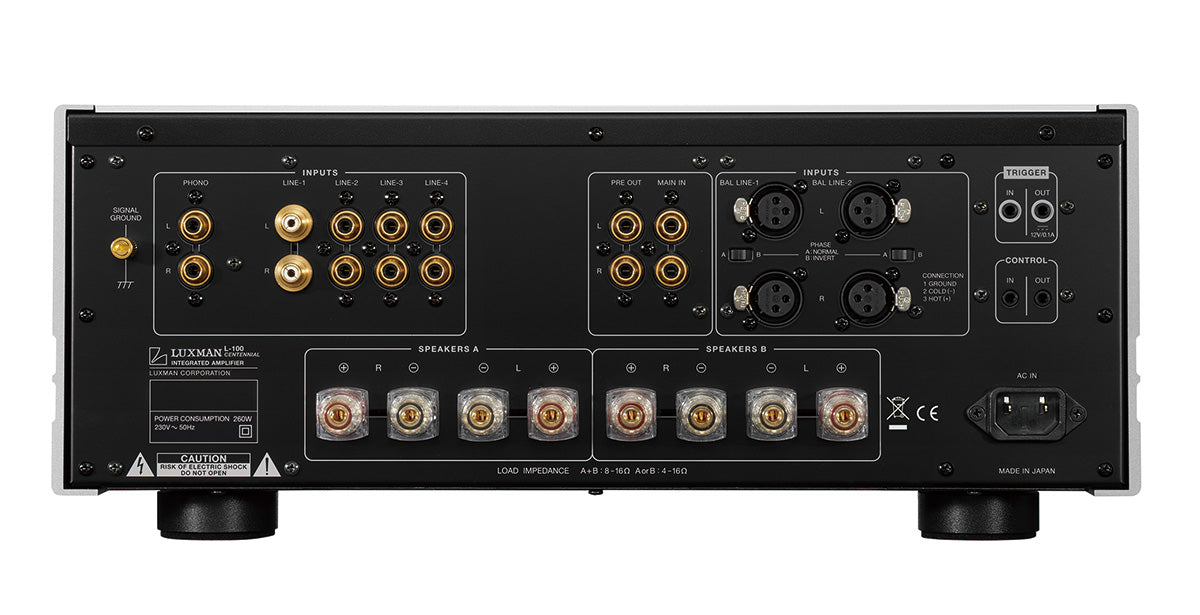
The L-100 Centennial offers four unbalanced RCA line inputs (LINE-1 through LINE-4), one balanced XLR line input (BAL. LINE-1), and a main-in for bypassing the preamp section when used with an external preamplifier. LINE-1 uses LUXMAN's original wide 20mm-pitch RCA terminals, accommodating large audiophile cable connectors; LINE-2 through LINE-4 use 18mm-pitch terminals. A PRE OUT provides a 1V output for driving an external power amplifier.
Two sets of speaker output terminals (A and B) support bi-wiring and are compatible with both Y-lug and banana plug terminations. An in-line terminal layout ensures equal signal path lengths across both channels. In addition to the standard 6.3mm headphone jack, a 4.4mm balanced headphone output with independent left and right channel ground wiring is provided, improving channel separation and imaging for compatible headphones.
Additional features include tone controls (Bass ±8 dB at 100 Hz, Treble ±8 dB at 10 kHz), loudness compensation, left/right balance adjustment, a mute function, and a LINE STRAIGHT mode that bypasses tone controls and loudness for a direct signal path. A MONO switch and phase inversion for the balanced input (PIN 2 standard HOT) are also included. 12V trigger input and output terminals and control input and output terminals allow integration with compatible LUXMAN components.
Build Quality and Design
All circuit boards for signal-path stages use peel-coat PCB technology, which eliminates the resistive coatings present on standard PCBs and reduces induced voltage that can degrade low-level signal integrity. Newly developed low-noise relays improve channel separation in the input selector circuitry. The chassis is supported by cast-iron density-gradient insulator feet, engineered with a gradually refined metallic structure from center to edge to suppress resonance, isolate the unit from surface-borne vibrations, and dampen internal mechanical resonance.
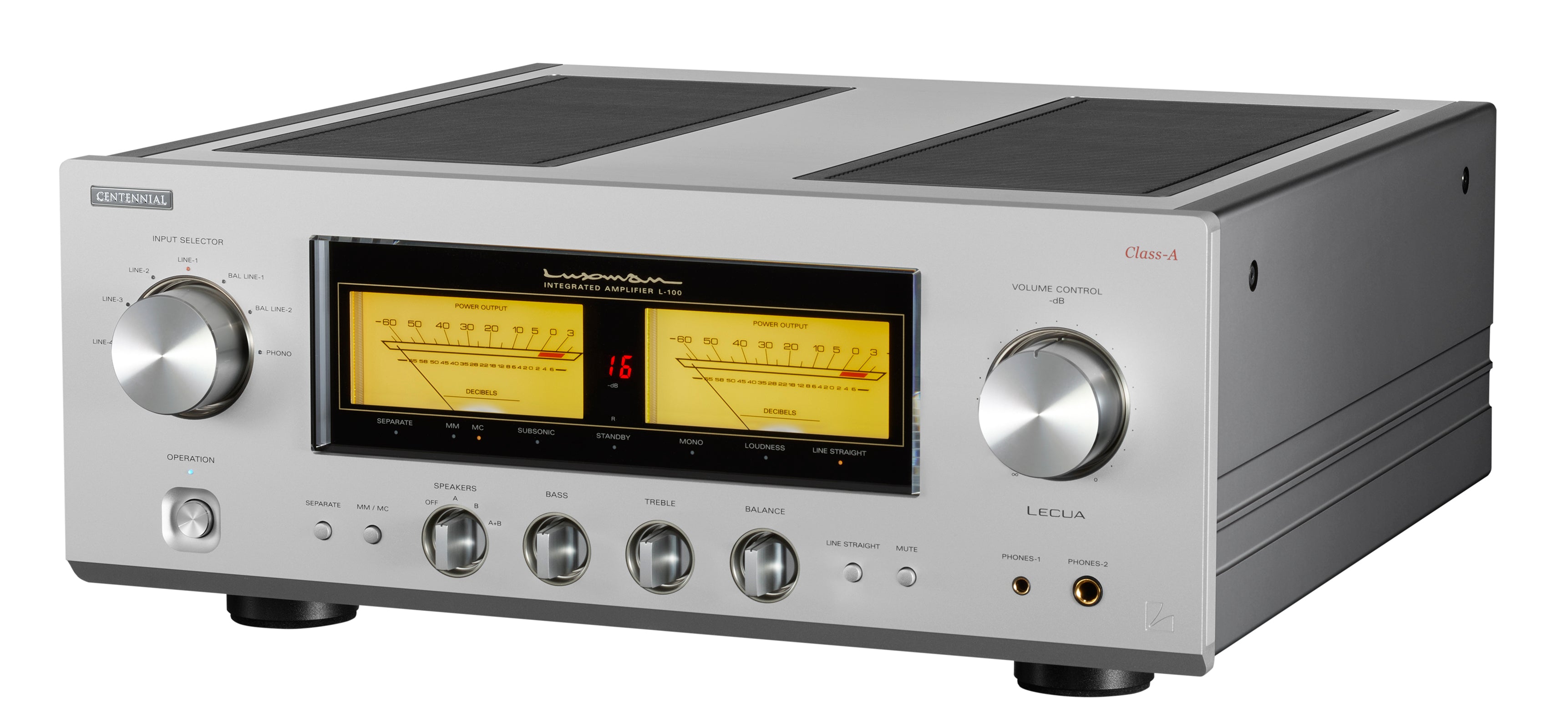
The front panel presents a refined visual identity: illuminated needle-type analog power meters with soft yellow backlighting respond dynamically to music, flanking the central 7-segment LED attenuation display. The brushed white panel finish is contrasted by the glossy chrome "CENTENNIAL" nameplate. The gold-plated AC inlet supports the full weight of heavy power cables. A premium aluminum remote control (RA-17A) is included and is also compatible with compatible LUXMAN CD players.
Centennial Series Context
LUXMAN was founded in Japan in 1925, and the Centennial series marks 100 years of continuous operation in high-end audio. The L-100 Centennial is not a commemorative limited edition but a current-production flagship intended for long-term ownership, built to anchor a system centered on the highest quality music reproduction. The Luxman L-100 Centennial is the definitive expression of LUXMAN's Class-A amplification philosophy at 100 years, combining a century of engineering refinement with the most advanced circuit technology the company has developed to date.




 Pay $0 today
 Trial
Trial
 Pay
Pay