Soulnote D-1 ver.2 D/A Converter
The Soulnote D-1 v2 is a standalone D/A converter built around a dual-mono ESS ES9038PRO configuration and a fully discrete, no-negative-feedback analog output stage. It is the Series 1 DAC in Soulnote's lineup and introduces several significant upgrades over the original D-1, including the New Type-R analog output circuit developed for the flagship E-3 phono equalizer, a resistor-based IV conversion stage that eliminates feedback from the entire analog section, a selectable NOS (non-oversampling) mode alongside the conventional FIR oversampling mode, and a power supply architecture built from eight independent discrete non-NFB regulators fed by a 260VA toroidal transformer. Digital inputs include USB, two coaxial S/PDIF, and AES/EBU.
DAC Architecture
ESS ES9038PRO: Independent Per-Channel Configuration
The D-1 ver.2 uses two ESS ES9038PRO DAC chips, one assigned exclusively to the left channel and one to the right. The ES9038PRO is a high-current-output DAC chip from ESS Technology. By running the chips independently per channel rather than in a shared or multiplexed configuration, each channel's DAC chip and its associated power supply operate in complete isolation from the other. Soulnote's description emphasizes the ES9038PRO's current output capability as a primary reason for its selection, and the eight-way discrete power supply is sized specifically to support this chip's demands at full performance.
Resistor IV Conversion Circuit
The output of a DAC chip is a current signal, which must be converted to a voltage before it can be used by an amplifier. This current-to-voltage conversion, referred to as IV conversion, is typically performed using an operational amplifier in a feedback configuration. The D-1 ver.2 instead uses a resistor-based IV circuit, the same type used in the higher-tier D-2 ver.2. A resistor IV stage performs the conversion passively, without an active feedback loop. Soulnote states that this approach enables the entire analog stage to operate with no negative feedback, which is the same design principle applied throughout the brand's amplifier lineup. The resistor IV circuit is described as crucial to achieving what Soulnote calls musical richness in the analog output.
New Type-R Analog Output Stage
Following the IV conversion, the analog signal passes through the New Type-R output circuit, the same topology originally developed for the E-3 flagship phono equalizer and adapted here for the DAC application. The power supply section for the analog stage also uses the same non-NFB regulator circuit found in the D-2 ver.2. The analog stage operates at an unusually high supply voltage of plus or minus 43V for a consumer DAC, a level Soulnote describes as power-amplifier class. The use of high supply voltage for the discrete output amplifier allows wider headroom and higher output levels: the balanced output of the D-1 ver.2 is rated at 5.8Vrms, with the unbalanced output at 2.9Vrms.
Analog Filter Minimization
A conventional DAC design includes a low-pass reconstruction filter in the analog domain after the DAC chip to remove high-frequency content that is a byproduct of digital-to-analog conversion. The D-1 ver.2 largely eliminates this stage, retaining only a first-order passive filter in the analog output path. The official description states that removing the analog filter enables what Soulnote calls organic and vibrant music reproduction consistent with the NOS operating mode, and that this approach is also effective during DSD playback. A first-order passive filter has a very gradual roll-off slope and adds no active circuitry or feedback to the signal path.
NOS and FIR Oversampling Modes
The D-1 ver.2 provides two selectable digital processing modes: conventional FIR oversampling and NOS (non-oversampling). In the standard FIR oversampling mode, the digital signal is upsampled using a finite impulse response filter that interpolates data points between the original samples. This produces a mathematically smoother waveform, but Soulnote notes that FIR filters produce pre-echo and post-echo artifacts in the impulse response, which are byproducts of the filter's calculation algorithm. The presence of pre-ringing and post-ringing in linear-phase FIR filters is a documented characteristic of this filter type.
In NOS mode, no digital oversampling is applied. The DAC chip converts the original sample data directly without interpolation, which eliminates the pre-echo and post-echo artifacts associated with FIR filters. Soulnote's stated rationale is that music waveforms consist of impulse signals of varying amplitudes, and that removing FIR processing preserves the time-domain accuracy of those impulses more faithfully. NOS mode is available for PCM inputs only; DSD operates in its own native conversion path and does not use the NOS mode setting.
Power Supply
260VA Toroidal Transformer
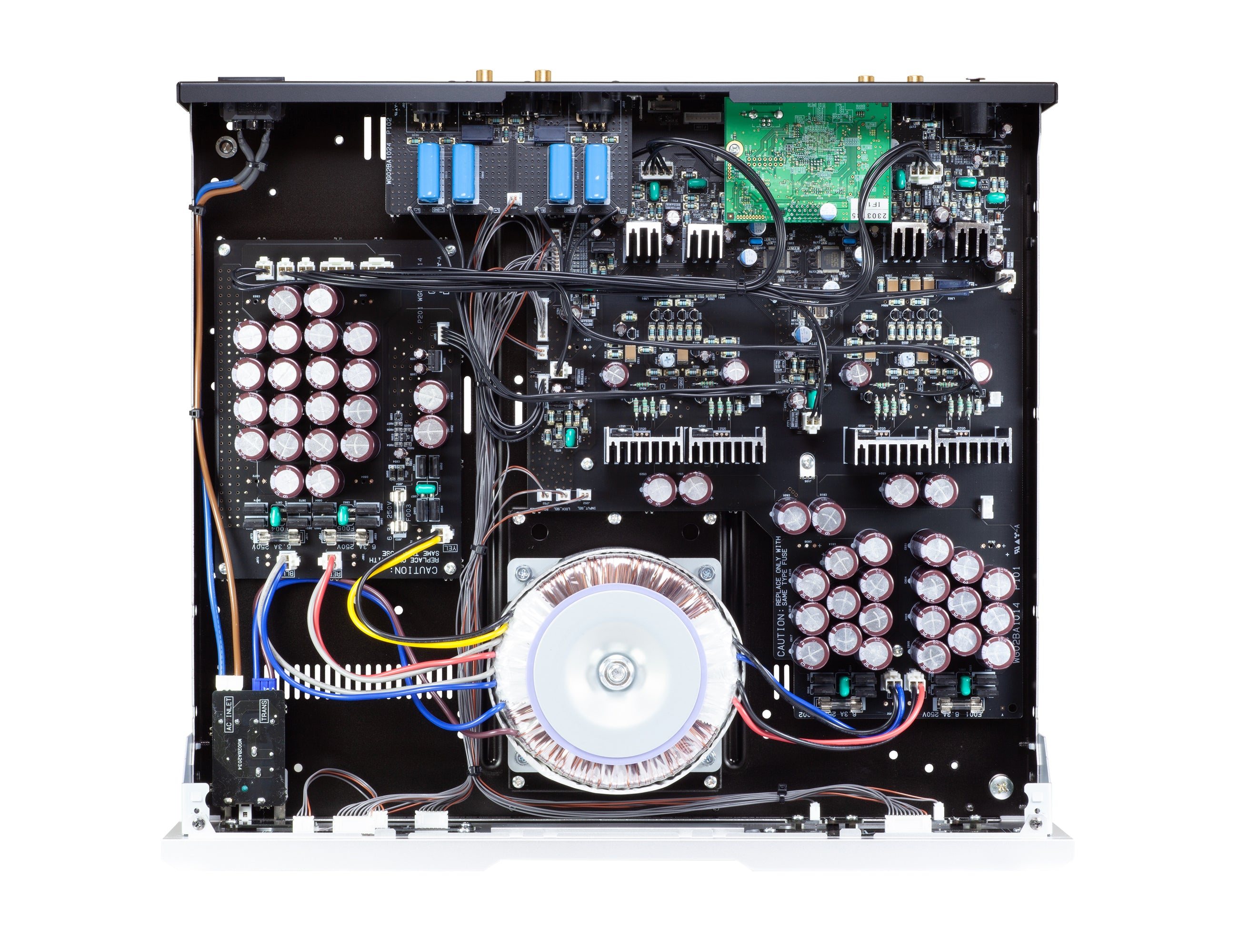
The D-1 ver.2 is equipped with a 260VA non-impregnated large toroidal power transformer, a capacity Soulnote describes as power-amplifier class for a DAC application. The transformer's secondary outputs power the analog stage at plus or minus 43V, an unusually high voltage for a source component, chosen to give the discrete non-NFB output amplifier sufficient supply headroom. Power consumption is rated at 20 watts.
Eight Independent Discrete Regulators
The D-1 ver.2 distributes power across eight separate supply rails, each regulated by Soulnote's own high-speed discrete non-NFB regulator design. The eight rails are: a dedicated analog power supply for the left-channel DAC, a dedicated analog power supply for the right-channel DAC, a dedicated digital power supply for the left-channel DAC, a dedicated digital power supply for the right-channel DAC, a crystal oscillator power supply, a USB interface power supply, a logic circuit power supply, and an S/PDIF differential receiver power supply. Each rail is independently regulated and isolated from the others. Soulnote states that this architecture is designed to extract maximum performance from the ES9038PRO, which has demanding power supply requirements.
Mechanical Design: Direct Mechanical Grounding Construction
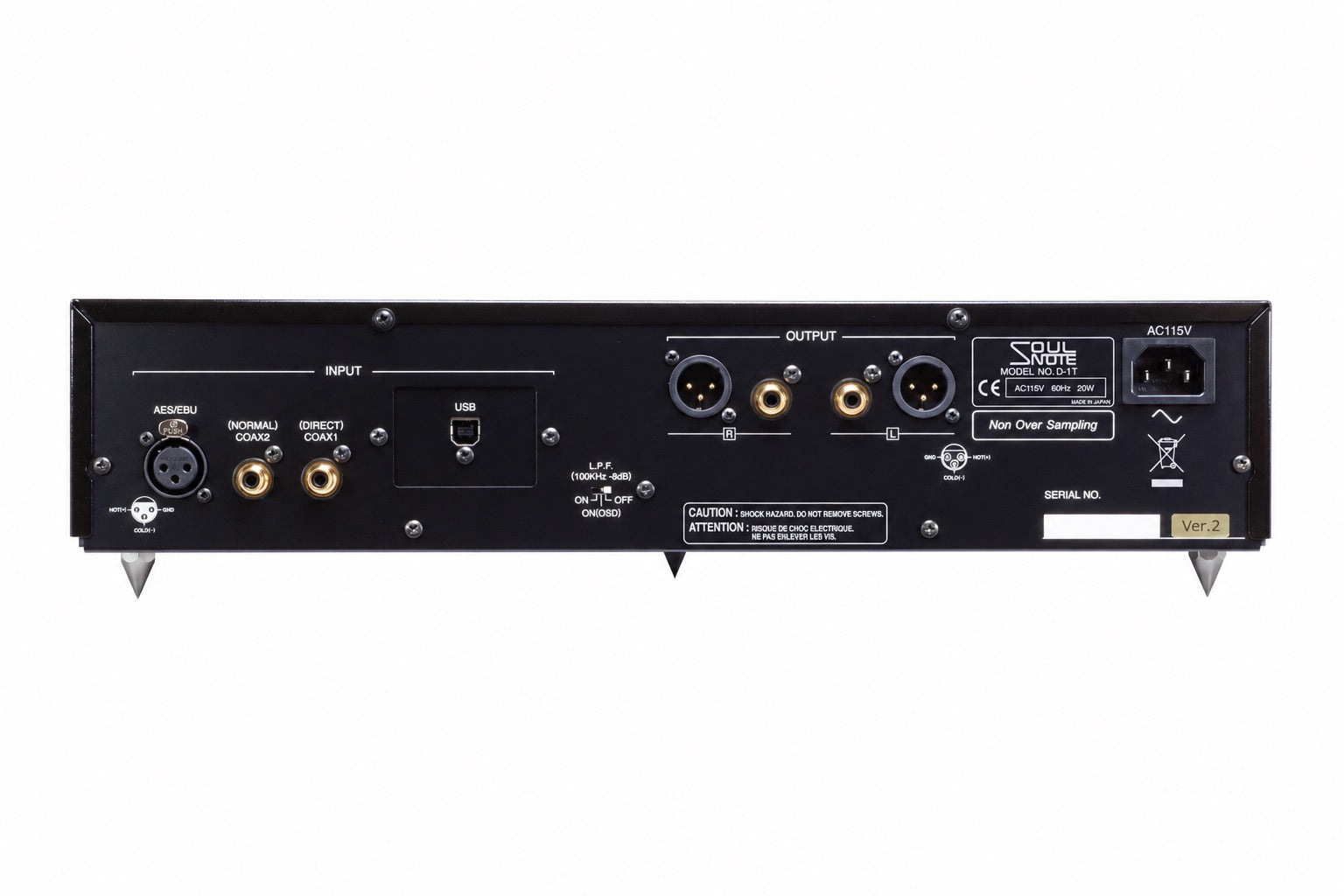
The D-1 ver.2 uses the three-point spike foot support system found across Soulnote's current product range, with one spike at the front and two at the rear. One of the rear spikes is positioned directly beneath the power transformer, providing a direct mechanical path for transformer vibration to exit the chassis rather than propagating through the chassis structure to the circuit boards. Spike feet are included as standard accessories.
Digital Connectivity
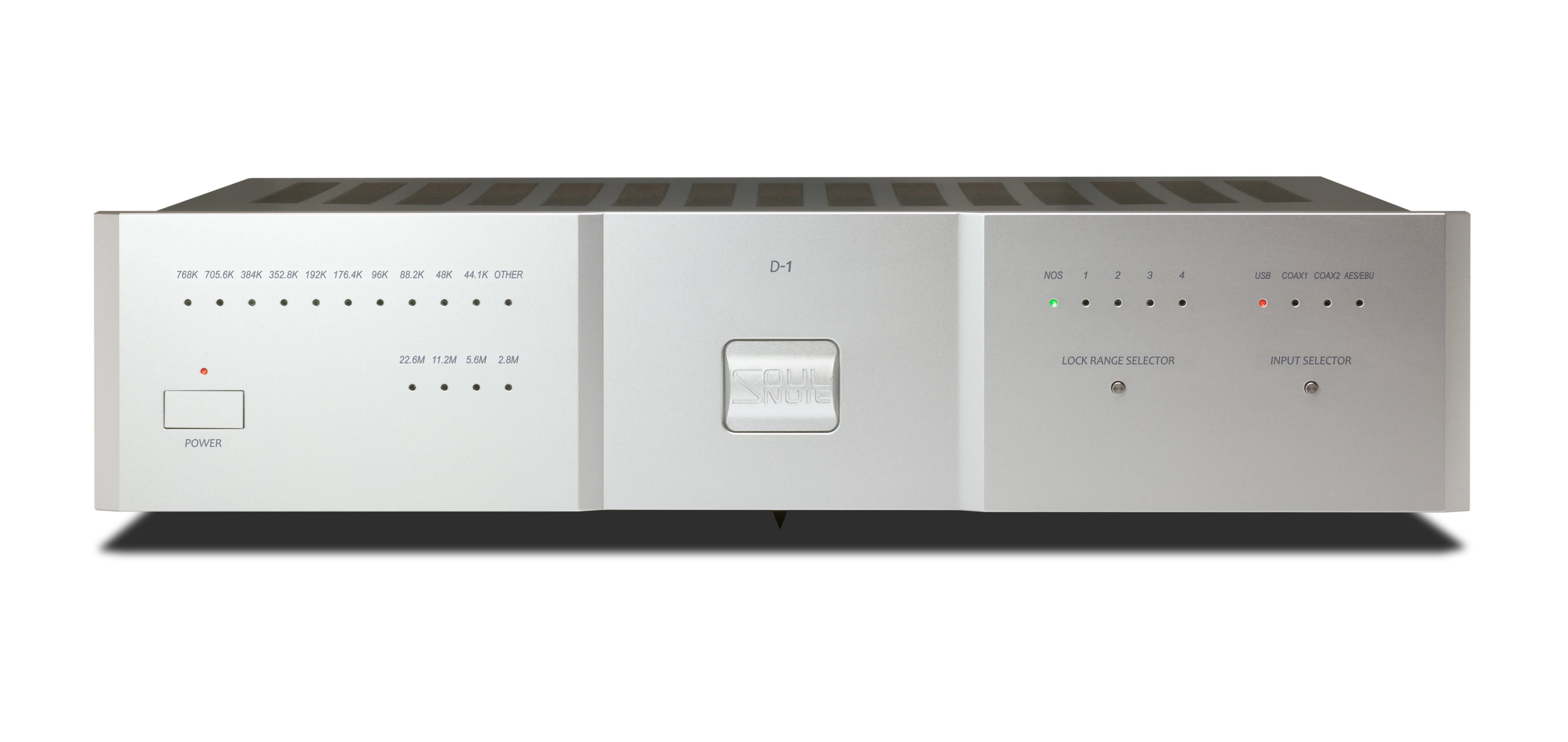
The D-1 ver.2 provides four digital inputs: one USB Type-B, two coaxial S/PDIF, and one AES/EBU. Via USB, the unit accepts PCM up to 768kHz at 16, 24, or 32-bit depth, and DSD up to 22.6MHz (DSD512) via DoP v1.1 or ASIO. Via coaxial and AES/EBU, the unit accepts PCM up to 192kHz at 16 or 24-bit, and DSD64 (2.8MHz) via DoP v1.1. The USB interface uses the USB 2.0 and USB Audio 2.0 profiles. Analog output is provided on one balanced XLR pair and one unbalanced RCA pair, with the balanced output rated at 5.8Vrms and the unbalanced at 2.9Vrms.
The D-1 ver.2 in the Soulnote Lineup
Soulnote's DAC lineup currently includes the D-1 ver.2 in Series 1, the D-2 ver.2 in Series 2, and the D-3 in Series 3. The D-1 ver.2 shares key circuit elements with the D-2 ver.2 including the resistor IV stage and the same class of non-NFB power supply regulators, while the New Type-R output circuit connects it directly to E-3 flagship technology. The D-1 ver.2 is designed to pair naturally within a Series 1 system alongside the A-1 v2 integrated amplifier and E-1 ver.2 phono equalizer, though its balanced output at 5.8Vrms and flexible digital input set make it compatible with a wide range of systems.
The Soulnote D-1 ver.2 is available in Premium Silver and Premium Black, is manufactured in Japan, and measures 430 x 109 x 379mm at a weight of 10.0kg.




 Pay $0 today
 Trial
Trial
 Pay
Pay