
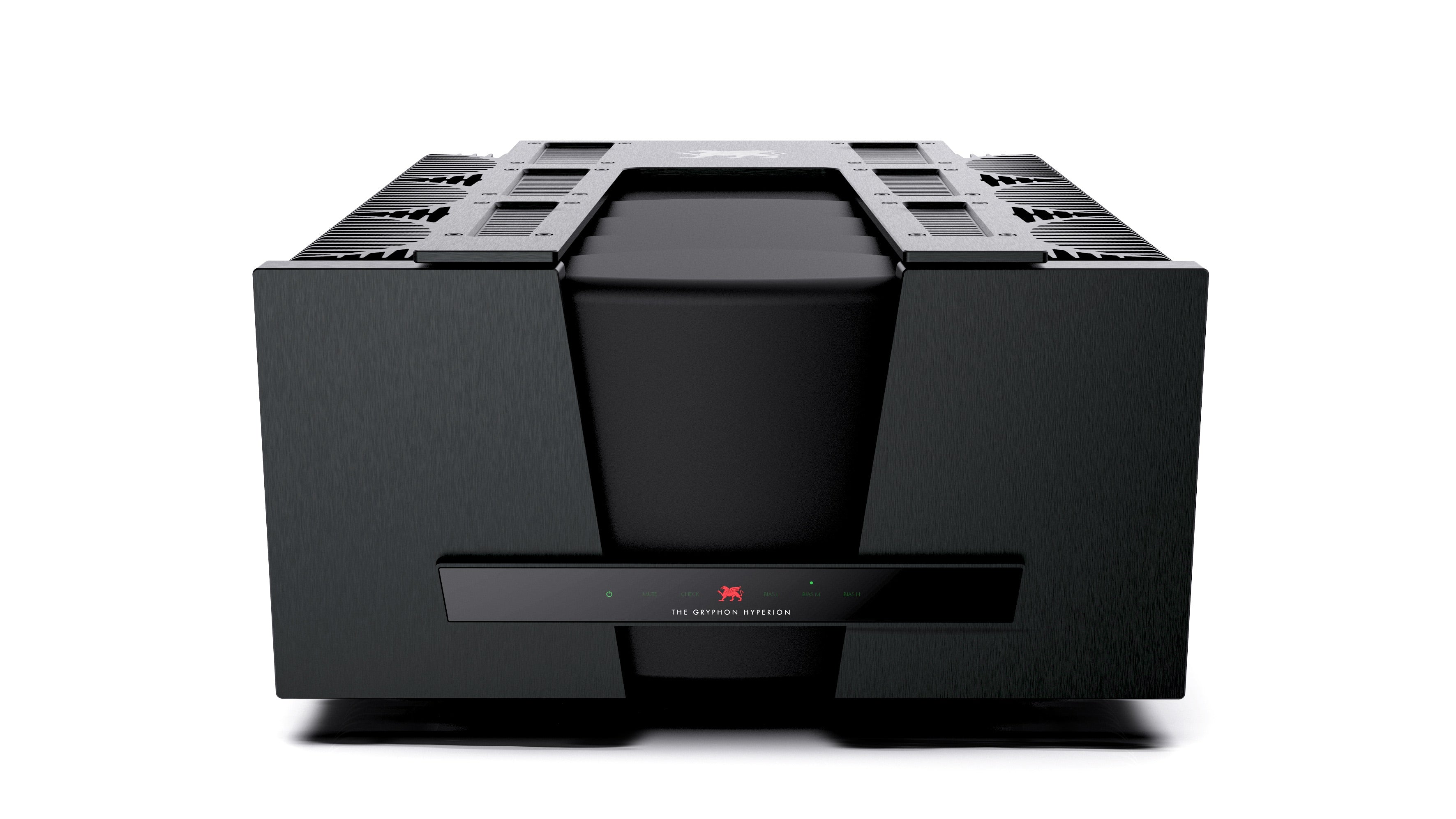
Some amplifiers are products. Others are events. The Gryphon Hyperion is the latter.
I was in Vienna when Gryphon unveiled it at High End Vienna 2026, and the room had a certain weight to it. It was the realization that something significant had arrived. The Mephisto had been Gryphon's reference power amplifier for 14 years, earning a reputation that very few components ever achieve. Replacing it was never going to be a small moment.
The Lineage
The Mephisto stood as one of the most respected power amplifiers in the world since its introduction in 2012. It set a standard for what pure Class A amplification could feel like: control of the speakers, power without edginess, and music delivered with presence.
The Hyperion draws directly from Gryphon's current flagship, the Apex, inheriting its output stage architecture, its internal solid-core pure silver wiring, and the same 40 high-current bipolar output transistors per chassis. In mono configuration, that becomes 80 transistors per pair. The Apex's DNA clearly runs through the Hyperion.
All of it flows from the same mind: Tom Møller, Gryphon's Chief Engineer and the man behind the electronic design of virtually every major Gryphon amplifier for more than 24 years. The Mephisto was his. The Apex was his. The Hyperion is his. With founder Flemming Rasmussen stepping back from creative direction at Gryphon, Møller now carries the torch, and the Hyperion is the first major amplifier to bear that fully.
What Gryphon built into the Hyperion beyond that inheritance is equally compelling: a newly developed dual J-FET input stage, mechanically decoupled transformer castings for each channel (an improvement over the Mephisto's shared casting), and a dedicated linear power supply for digital circuits where the Mephisto used a switched-mode design. The capacitor bank reaches 500,000 µF per chassis, more than 10% above the Mephisto.
These are not incremental refinements. They represent a fundamental rethinking of what Mephisto-class performance could become with the engineering knowledge gained from building the Apex.
What Pure Class A Means Here
Pure Class A operation means the output stage conducts continuously, eliminating the crossover distortion that creeps into Class AB designs. The trade-off is heat and power consumption, which the Hyperion addresses with over-built heat sinks and a three-position bias system (Low, Mid, and High) that can be managed automatically when paired with a compatible Gryphon preamplifier via the Green Bias link.
The amplifier uses zero global negative feedback, a Gryphon design philosophy that has defined the brand's sound for decades. The result is a presentation Gryphon describes as neutral and ethereal, where music feels unprocessed, direct, and fully alive. Bandwidth extends from 0.3 Hz to 330 kHz. Output impedance in stereo is 0.025 ohms. In mono, 0.010 ohms.
In stereo, the Hyperion delivers 180W per channel into 8 ohms, doubling to 360W at 4 ohms and 720W at 2 ohms. In mono, each chassis delivers 200W into 8 ohms, 400W into 4, and 800W into 2. This is an amplifier that will drive anything, without strain, without compromise.
A New Design Language
The Hyperion is also the start of something visually new for Gryphon. The chassis is striking in a way that is hard to describe until you are standing in front of it. Modern, cleaner than anything Gryphon has produced before, and unequivocally robust and masculine. It does not look like it is trying to be beautiful. It simply is.
The design is the work of Søren Slebo, a long-term Gryphon designer responsible for the brand's mechanical and industrial design. The Helios preamplifier was the first product to introduce his new visual language, and the Hyperion follows it. The inspiration, according to Gryphon, is the movement and force of a waterfall. The result is a more sculptural form that retains the brand's signature Nordic Noir finish and its inverted triangle motif, now integrated more subtly into the overall shape rather than announced outright. It is unmistakably Gryphon, yet unmistakably new.
It is the first generation of Gryphon products developed without visual design input from founder Flemming Rasmussen, and it stands on its own. If this is the direction, the next chapter of Gryphon design is worth watching.
Gryphon's Sales Director Rune Skov put it well: they preserved the design language that defines the brand while taking a deliberate step toward what comes next. It honors the heritage and looks firmly forward.
Built to Last
Gryphon has never been casual about materials or construction, and the Hyperion reflects that. The chassis weighs 126 kg per unit. Internal wiring matches the Apex specification in pure silver. Circuit boards are four-layer with copper traces up to 105 microns. Firmware is upgradeable via USB. The protection system is non-intrusive, placing nothing in the signal path during normal operation.
Hearing It at Unveil Sound
The Gryphon Hyperion is arriving at our studio, and we will have it on display for private listening sessions.
This is not a component you want to evaluate on paper. Specs can describe power and bandwidth. They cannot describe what it feels like when an amplifier of this caliber takes control of the speakers and disappears.
The Hyperion stereo is priced at $80,200. The mono pair is available at $160,400. Shipping begins late summer 2026.
If you want to hear it for yourself, reach out and we will set up a private listening session at the studio. There is no pressure, no sales pitch. Just the music, the room, and the kind of sound that stays with you.
Contact us to arrange your listening session.
Enjoy every listen, JC - Unveil Sound
 Pay $0 today
 Trial
Trial
 Pay
Pay