
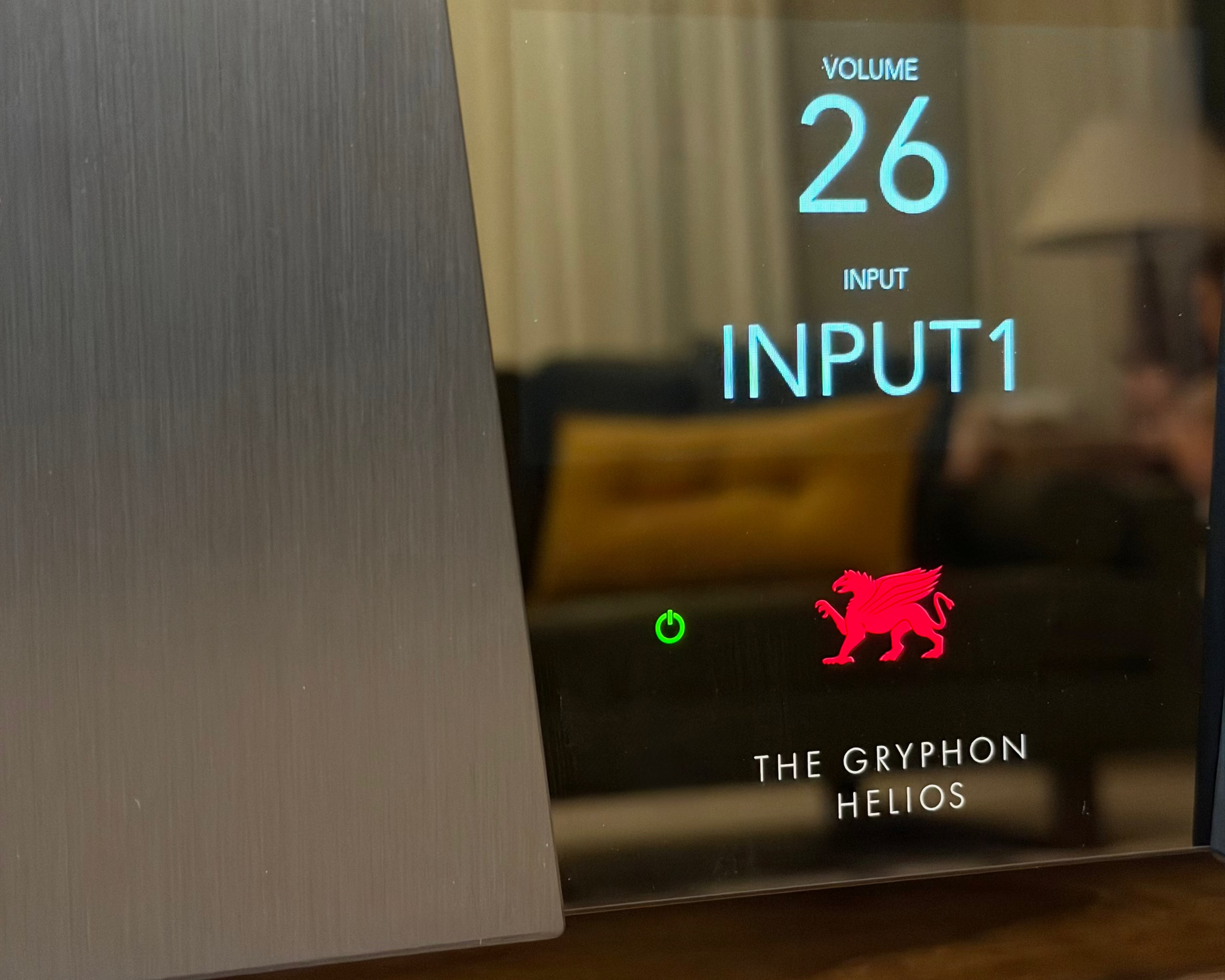
As the successor to the long-running Pandora, the Gryphon Helios sits just below the Gryphon Commander. The same dual JFET input buffer design that Gryphon developed for the Commander made its way into the Helios, along with the philosophy behind it: no global negative feedback, and nothing in the signal path that doesn't need to be there.
The Build
Two chassis, each housing dual mono circuits, extruded and CNC-machined aluminum throughout, and a faceplate that borrows Gryphon's Nordic Noir language while introducing a new visual identity meant to carry the brand forward. It's a bold, deliberate design. The build quality is off the charts. Gryphon has never made anything that felt built to a budget, and the Helios doesn't break that pattern. All the touch points feel premium, as expected. From the remote to the brushed finish, everything exudes quality.
The Helios is also built to grow with the HiFi system. Two blank panels on the rear accept Gryphon's DAC3 digital module and PS3 phono module, the same modules used in the Diablo 333. The 4.3-inch touchscreen tucked behind thick tempered glass handles day-to-day operation.
In the Room
We ran the Helios across three very different amplifiers to see how it would behave outside a full Gryphon system: the Goldmund Telos 800, the Nagra Reference Amps, and the Nagra Classic Amp. Source was the Playback Designs MPD-8, connected via a fiber-optic link to the Nagra Streamer. Speakers were the Marten Mingus Quintet Statement. All cabling used was from Jorma. We also plan to run this with the brand new Gryphon Hyperion once it arrives at our studio this September.
What stood out first was dynamics. "Dance of the Tumblers," recorded by the Minnesota Orchestra, seems to be built for testing exactly this: a piece that swings from delicate strings to full brass and percussion with almost no warning. Through the Helios, those swings arrived with an ease we didn't expect, and that held true across all three amplifiers. Each one sounded a little more awake with the Helios in front of it than without. It is clear the Helios is designed to disappear into the system rather than color it.
Yuri Honing Trio's take on "Walking on the Moon" is a track we use often to gauge the sense of space between instruments created by a system. It's a spacious, largely improvised recording that rewards transparency and punishes anything that muddies the air between saxophone, bass, and drums. The Helios kept each instrument in its own pocket of space without any of them fighting for room, and the sustain on Honing's sax stayed textured rather than smeared into the mix. Nothing about the presentation called attention to itself, which is the point. The sense of space was remarkable. Instruments felt suspended in the air, coming out of nowhere. The background was completely "black."
For texture, we spent time with Buika's "Volver, Volver." Her voice carries an enormous amount of grain and rasp in a good recording, and the Helios let all of it through without adding any edge or brightness of its own. That grain held up throughout the performance. Lesser preamplifiers tend to smooth things over just enough to lose the character in the voice. The Helios continued to impress the more we listened.
Where It Sits
The Gryphon Helios is a preamplifier that can stand tall beyond just sitting in the shadow of the Commander. It's a genuine entry point into the Gryphon design philosophy, with real trickle-down engineering rather than just a marketing story. Whether it's the right preamplifier for a given system depends on the rest of the system and what a listener is chasing, which is always what keeps the search for a preamp interesting.
This is what we've found out after the first fifteen hours. We'll keep listening, try more pairings, and follow up as we spend more time with the Helios. As of now, we're very impressed with what we're hearing.
If you're curious how the Helios might sound in your own space, reach out to us.
Until the next time,
JC
 Pay $0 today
 Trial
Trial
 Pay
Pay