
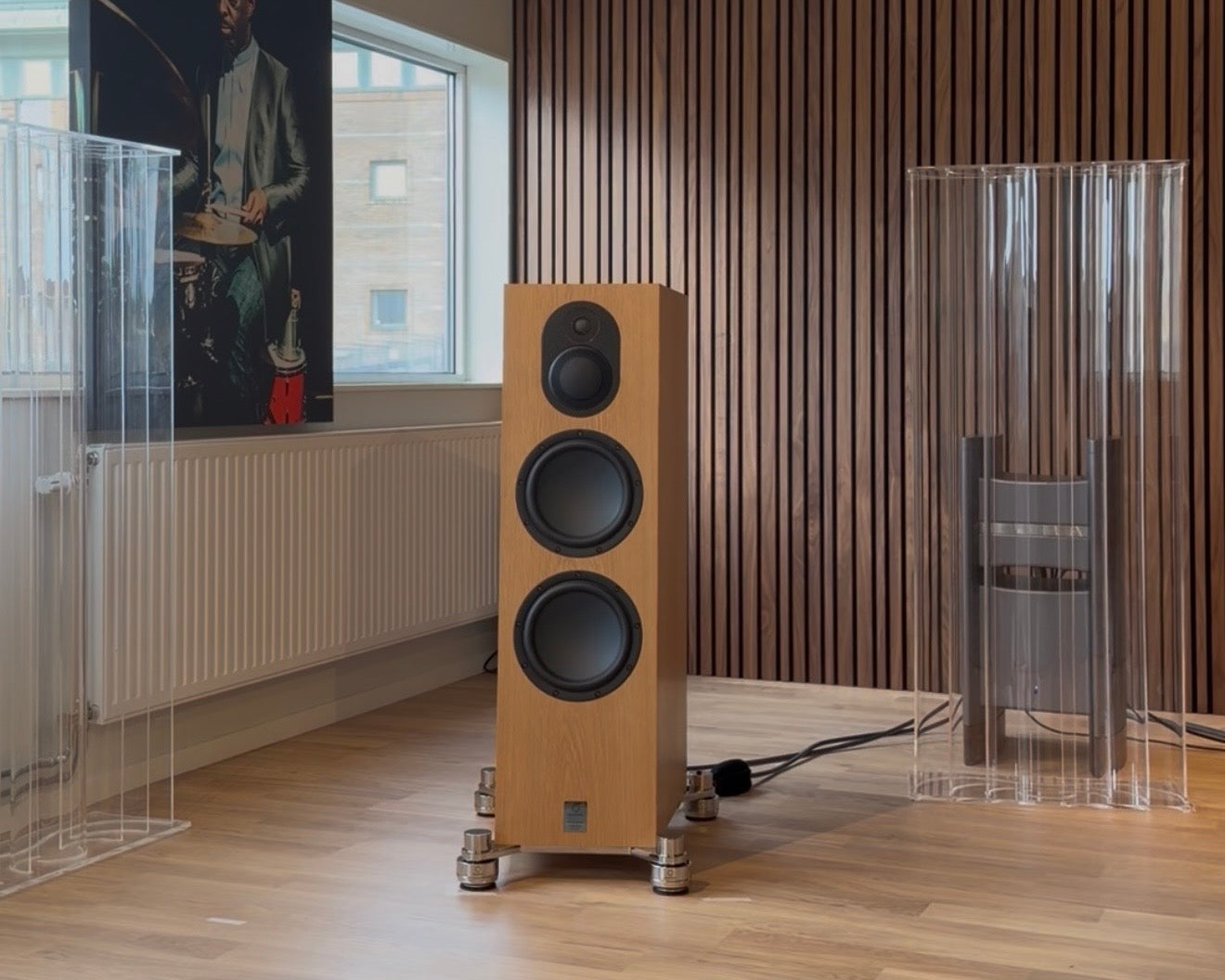
The Marten Dexter is the newest speaker from Marten. I heard it for the first time at its world premiere in Vienna. I heard it again, more fully, at Marten's facility in Gothenburg a few days later. By the time I left Sweden, I was already thinking about where to place them in our studio.
Marten is one of the brands we carry and one I know very well. That familiarity made my time in their listening rooms feel less rushed and more like a conversation. They build speakers the way people who genuinely love music build speakers, with care and without shortcuts. The Dexter reflects that.
What I Heard
Vienna was the world premiere, Room 1.32, the Quintet running on Goldmund electronics and a TechDAS turntable. It sounded incredible, but I still wanted more time with it.
Gothenburg gave me that. Very few people outside of Marten's own team have had the chance to hear the Dexter in their private listening rooms. I was one of them, and the difference between a show floor and a dedicated, well-treated space built for exactly this purpose is not subtle. No ambient noise bleeding under the door, no schedule to keep. Just the speaker and time.
The first thing you notice is the warmth. Bass and midrange arrive together as a single impression, a richness and body that settles you into the music before you have started thinking about it. Piano makes the case well: every note has weight and true pitch, the strike, the sustain, the decay, each one resolved cleanly. Nothing lingers more than it should.
What makes the Dexter interesting is what comes with that warmth. The diamond tweeter means the detail is all there, the top end extended and smooth, never glaring, never bright. The richness and the precision coexist. That balance is harder to achieve than it sounds.
The result is a speaker that sounds complete. Wide soundstage, settled and stable. A low end with real reach and shape. A midrange with body and texture. Highs that inform rather than intrude. And an overall ease that suggests a speaker working comfortably within its capabilities, not at the edge of them.
I left Gothenburg with a straightforward feeling about the Dexter: it is one of the most musically satisfying speakers in its range, from a brand I trust. Needless to say, we placed an order for a couple of Statement models.
Named After a Legend
Marten names its loudspeaker families after jazz musicians. Coltrane. Mingus. Parker. Oscar. Dexter continues that tradition, named after Dexter Gordon, the saxophonist whose sound was all presence and warmth and unhurried authority. Spend time with these speakers and the name starts to make sense.
Four Models. Two Editions. All Diamond.
The Dexter series comprises four models, and every one of them carries a pure diamond tweeter. Not reserved for the top of the range, not offered as an upgrade. Standard, across all four. That tweeter traces its development to work Marten did on the Coltrane Supreme Extreme, their reference loudspeaker, and what it contributes to the upper frequencies is immediately apparent: an openness and ease that does not call attention to itself but that you would notice immediately if it were gone.
The Dexter Duo is the standmount of the family, from $29,000. A two-way design with a ceramic mid/bass driver and diamond tweeter, wired internally with Jorma Duality cable and built by hand in Sweden. For smaller rooms or listeners who want something precise and compact without giving anything important away.
The Dexter Trio, from $47,000, brings the same driver configuration into a slim floorstander. More cabinet volume, more weight in the lower registers.
The Dexter Quartet, from $60,000, steps into three-way territory with a dedicated ceramic midrange driver and carbon fibre bass drivers. The midrange in a three-way design has room to breathe in a way a two-way cannot fully offer. Voices and acoustic instruments benefit most.
The Dexter Quintet, from $70,000, is the flagship of the range. Three-way, ceramic midrange, carbon fibre bass drivers, diamond tweeter. This is the model I spent the most time with in Gothenburg, and the one that made the clearest case for what the Dexter series is capable of.
All four are available in a standard edition with Jorma Duality internal wiring and in a Statement Edition with Jorma Statement cabling and upgraded crossover components. Knowing Marten, I expect the standard to be excellent. The Statement is incredible.
The Loaded Reflex Line
For the Dexter, Marten developed a new bass loading system they call the Loaded Reflex Line. It is a hybrid design that draws from both bass reflex and transmission line principles in a single enclosure. In practice this means bass that is fuller and better defined than a conventional reflex design, and considerably more forgiving of room placement than a pure transmission line.
In Marten's listening room I heard this on music with real low-frequency complexity. The bass was present, articulate and controlled. Rich without becoming loose. And the speaker responded well to different positions in the room, which in a real listening environment matters as much as anything on a specification sheet.
At Unveil Sound in September
The Marten Dexter arrives at our studio in September. We will have the Dexter Duo and the Dexter Quartet available for private listening, both in Statement Edition, the highest specification Marten offers within the range. We are the exclusive Marten dealer in the Pacific Northwest, and we are looking forward to sharing them.
If you want to book a September listening session, or if you already know which model belongs in your room, reach out and we will set it up. You can also place a preorder today and we will be in touch as your speakers move through production.
These are worth hearing in person. Contact us to set up your visit.
Enjoy every listen, JC - Unveil Sound
 Pay $0 today
 Trial
Trial
 Pay
Pay